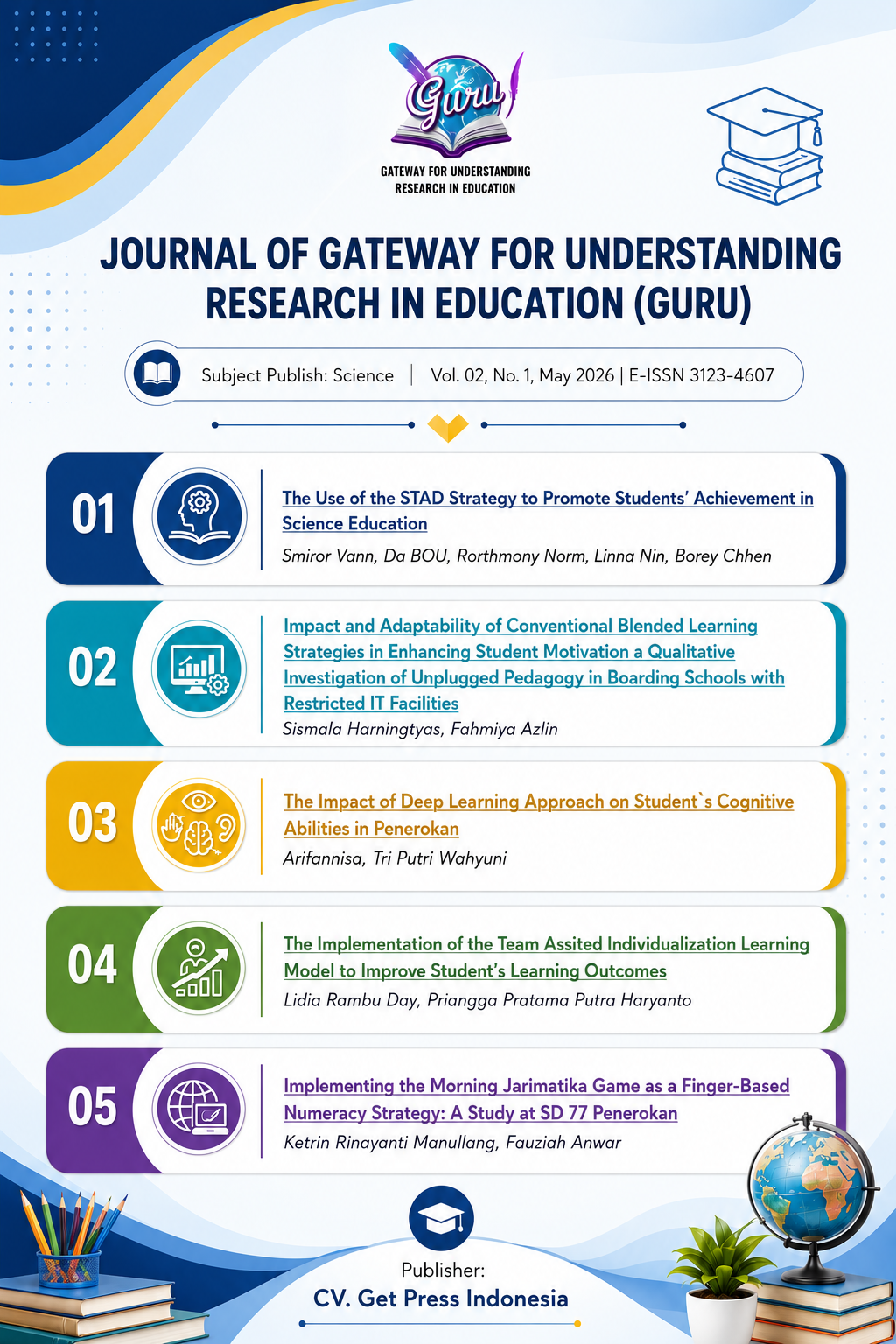
The Impact of Deep Learning Approach on Student`s Cognitive Abilities in Penerokan
DOI:
https://doi.org/10.69855/guru.v2i1.644Keywords:
Deep Learning, Cognitive Abilities, Elementary School LearningAbstract
Traditional teacher-centered instruction often hinders the development of critical thinking, leading to poor cognitive outcomes. At SD 48/1 Penerokan, only 8 of 28 students achieved learning mastery. The purpose of the study was to determine the influence of deep learning learning on the cognitive improvement of students in elementary school. Using a quasi-experimental post-test only control group design, the study compared an experimental class using deep learning with a control group. Results showed the experimental group averaged 74.80, significantly higher than the control group's 67.20. A t-test confirmed a significant difference (0.037 < 0.05). Thus, the deep learning approach effectively enhances students' cognitive abilities.
References
Alam, A. (2023). From teacher-centered to student-centered learning: The role of constructivism and connectivism in pedagogical transformation. Journal of Educational Transformation, 11(2), 154–167.
Chen, J., & Singh, C. K. S. (2024). A systematic review on deep learning in education: Concepts, factors, models, and measurements. Journal of Education and Educational Research. https://doi.org/10.54097/gzk2yd38
Chen, X., et al. (2024). Deep learning. Elsevier.
Hadi, M. S., Setiawan, V., & Hidayah, P. M. (2025). The effect of implementing deep learning on improving students’ cognitive abilities in the independent curriculum at Yogyakarta high schools. Journal of Research in Innovative Education, 7(1). https://doi.org/10.25217/jrie.v7i1.5637
Haq, M. D., & Prasetiyo, N. T. (2025). Deep learning as a transformational approach in education: A literature review. Journal of Educational Studies, 8(3), 1826–1842.
Hidayat, M. A., Agustin, D. T., Hana, N., Ramadhani, R., & Ayu, D. (2025). Advantages of implementing the Merdeka Curriculum based on a deep learning approach at SDN 1 Sungai Besar. Journal of Primary Education Development, 10, 251–264.
Hitzler, P., Rayan, R., Zalewski, J., Norouzi, S. S., & Eberhart, A. (2025). Deep deductive reasoning is a hard deep learning problem. https://doi.org/10.3233/NAI-240669
Le, H. V., & Nguyen, L. Q. (2024). Promoting L2 learners’ critical thinking skills: The role of social constructivism in reading class. Frontiers in Education, 9, 1–12. https://doi.org/10.3389/feduc.2024.1241973
Nurdiana, H., & Pradana, S. P. (2025). Effectiveness of the deep learning approach in improving students’ cognitive learning outcomes in Grade VIII science classes at Pandanaran Plupuh Junior High School. Journal of Science Education Research, September, 46–53.
Pendidikan, J. C., Studi, P., Matematika, P., & Makassar, U. N. (2025). Deep learning approach from a theoretical perspective. Journal of Mathematics Education, 5, 33–43.
Suardin, D., Sani, N. K., Jarnawi, M., Zaky, M., & Khuzaimah, A. U. (2025). The influence of the deep learning approach on students’ physics learning outcomes. Journal of Educational Research, 8(3), 1586–1595.
Vidergor, H. E. (2022). Effects of innovative project-based learning model on students’ knowledge acquisition, cognitive abilities, and personal competences. Interdisciplinary Journal of Problem-Based Learning, 16(1). https://doi.org/10.14434/ijpbl.v16i1.31183
Wr, T. W. W., Fitriani, D., & Oktaviana, F. (2026). Deep learning in Indonesian education: Conceptual foundations, policy frameworks, and implementation. Journal of Educational Policy and Practice, 4(November 2025).
Wu, L. (2025). Nexus of faculty feedback quality and students’ deep approaches to learning in general education: A mixed-methods study. SAGE Open, 19, 1–13. https://doi.org/10.1177/21582440251328081
Zhang, J. (2020). The application of human comprehensive development theory and deep learning in innovation education in higher education. Frontiers in Psychology, 11, 1–11. https://doi.org/10.3389/fpsyg.2020.01605
Downloads
Published
How to Cite
Issue
Section
License
Copyright (c) 2026 Gateway for Understanding Research in Education

This work is licensed under a Creative Commons Attribution 4.0 International License.