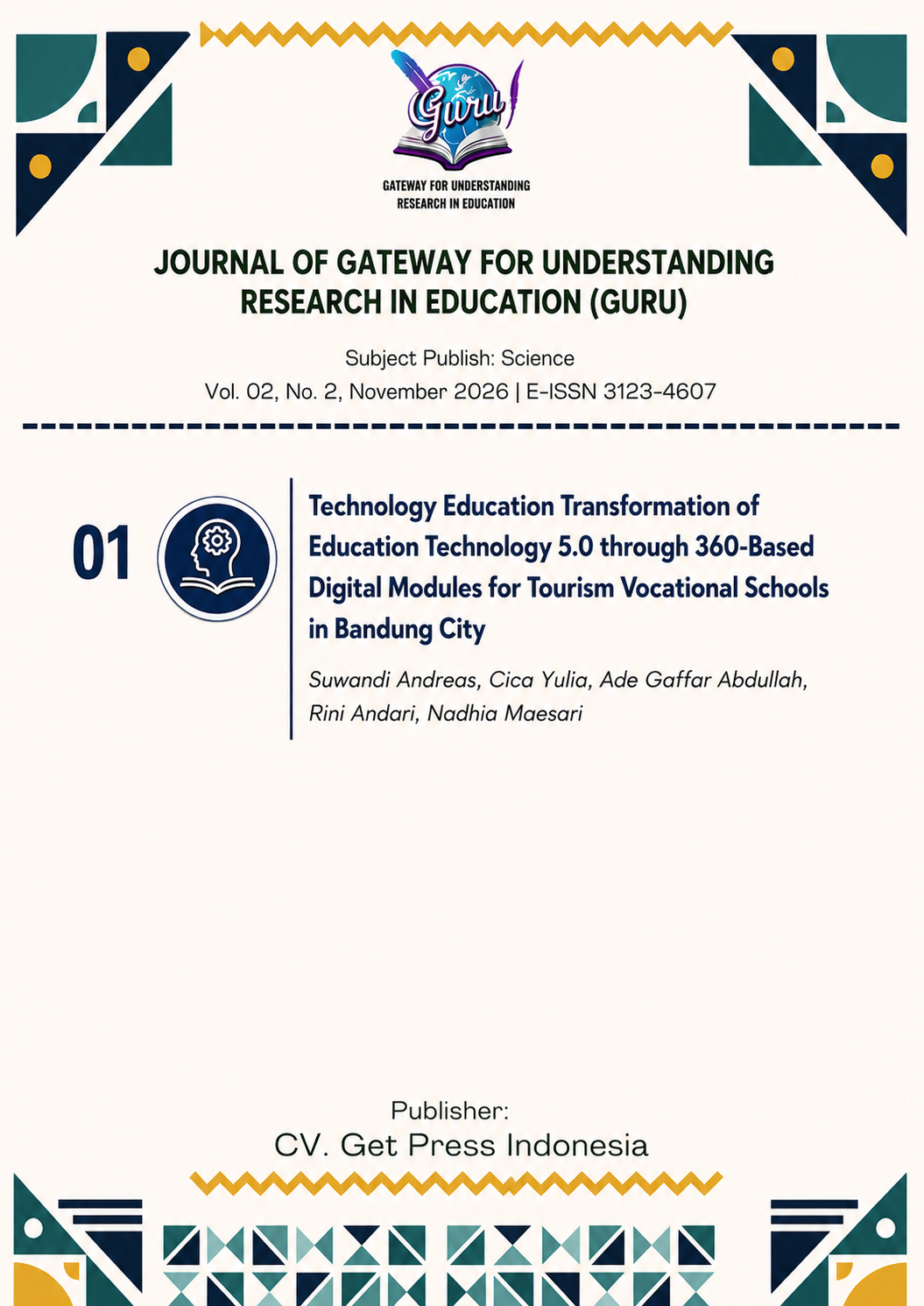
Technology Education Transformation of Education Technology 5.0 through 360-Based Digital Modules for Tourism Vocational Schools in Bandung City
English
DOI:
https://doi.org/10.69855/guru.v2i02.559Keywords:
Transformation, Educational Technology, Tourism Vocational SchoolsAbstract
The concept of Digital Education 5.0 in tourism education emphasizes the integration of scientific and technological innovations to create an effective, interactive, and future-oriented learning environment. This study aims to examine the role of Digital Education 5.0 transformation through the incorporation of science and technology innovations, particularly in Tourism Vocational Schools. A qualitative approach was employed using literature review, interviews, and observation methods. Data were collected from relevant academic sources, interview results, and field observations to develop a comprehensive understanding of Digital Education 5.0 and its application in tourism vocational education. The participants in this study consisted of 100 students from Tourism Vocational Schools. Data analysis was conducted using descriptive and verification techniques to systematically interpret the findings. The results indicate that the implementation of Digital Education 5.0 provides significant opportunities to improve teaching and learning processes. The integration of advanced technologies such as artificial intelligence, virtual reality, and the Internet of Things supports the development of a technology-based learning ecosystem that enhances students’ motivation, engagement, and participation. Furthermore, innovative pedagogical approaches, including flipped classroom, blended learning, and personalized learning, enable educators to deliver learning materials in more flexible and engaging ways while fostering effective collaboration between teachers and students. However, the transition toward Digital Education 5.0 also presents challenges related to technological readiness and the need for continuous capacity building for both teachers and students.
References
Afrila, D., & Yaymayani, A. (2018). Development of interactive learning media using Adobe Flash software for the Economic Mathematics course at Batanghari University Jambi. Jurnal Ilmiah Universitas Batanghari Jambi, 18(3), 539–551.
Ahmed, Y. A., & Ahmed, H. A. (2005). Utilisation and benefits of instructional media in teaching social studies courses as perceived by Omani students. Malaysian Online Journal of Instructional Technology, 2(1).
Arsyad, A. (2014). Learning media. PT Rajagrafindo Persada.
Asyhar, R. (2012). Creatively developing learning media. Gaung Persada Press.
Bunchball. (2010). Gamification 101: An introduction to the use of game mechanics. https://doi.org/10.1016/j.compedu.2012.12.020
Creswell, J. W. (2018). Research design: Qualitative, quantitative, and mixed methods approaches (5th ed.). Sage Publications.
Dahar, A. D., Mustakim, S. B., & Shahroni, N. (2022). Literature review: Technical and vocational education and training (TVET) in Malaysia. https://ejournal.bumipublikasinusantara.id/index.php/ajsed
Dopades, M., & Adi, A. E. (2022). 360-degree video as a promotional medium for MSME products in Bandung Regency. Charity, 5(1), 13.
Fonda, A., & Sumargiyani. (2018). The developing math electronic module with scientific approach using Kvisoft Flipbook Maker Pro for XI grade senior high school students. Infinity Journal of Mathematics Education, 7(2), 109–122.
Handani, S. W., Suyanto, M., & Sofyan, A. F. (2016). Implementation of gamification concepts in e-learning for three-dimensional animation learning. Jurnal Telematika, 9(1), 42–53. https://doi.org/10.2214/ajr.181.6.1811716b
Hermawan, I., Adah, N. N., & Administrasi, J. (2021). Developing the feasibility of 360-degree video-based e-tourism as a push-promotion strategy. 556–571.
Ifenthaler, D., Eseryel, D., & Ge, X. (2012). Assessment in game-based learning. Springer.
Imansari, N., & Sunaryantiningsih, I. (2017). The effect of interactive e-modules on students' learning outcomes in occupational health and safety materials. Jurnal Ilmiah Pendidikan Teknik Elektro, 2(1), 11–16.
Jusuf, H. (2016). The use of gamification in the learning process. Jurnal TICOM, 5(1), 1–6.
Köhler, T., Wollersheim, H.-W., & Igel, C. (2019). Scenarios of technology-enhanced learning (TEL) and technology-enhanced teaching (TET) in academic education: A forecast for the next decade and its consequences for teaching staff.
Manabung, S. E., Tulenan, V., & Rindengan, Y. D. Y. (2019). A 360-degree virtual photo tour of Prof. Dr. R. D. Kandou General Hospital, Manado. Jurnal Teknik Informatika, 14(2), 221–226.
Martin, F., Hoskins, O. J., Brooks, R., & Bennett, T. (2013). Development of an interactive multimedia instructional module. The Journal of Applied Instructional Design, 3(3).
Muawwal, A., Zaman, B., & Arianti. (2021). Development of an interactive virtual tour system (360° view) as a tourism marketing solution during the COVID-19 pandemic: A case study of Fort Rotterdam. Jurnal Instek Informatika Sains dan Teknologi, 6, 272–281.
Nurmayanti, F. (2015). Development of an electronic physics module using the PDEODE strategy on the kinetic theory of gases for Grade XI senior high school students. In Proceedings of the National Symposium on Innovation in Science Learning. Bandung Institute of Technology.
Nuriansyah, F. (2020). The effectiveness of online learning media in improving learning outcomes among economics education students during the early COVID-19 pandemic. Jurnal Pendidikan Ekonomi Indonesia, 1(2), 61–65.
Nwosu, J. C., Chukwudi, J. H., & Ehud, M. M. (2017). The use of instructional media among selected science teachers in Ilishan Remo Senior Secondary Schools, Ogun State. Journal of Educational Policy and Entrepreneurial Research, 4(1), 61–71.
Omodara, O. D., & Adu, E. I. (2014). Relevance of educational media and multimedia technology for effective service delivery in teaching and learning processes. IOSR Journal of Research & Method in Education, 4(2), 48–51.
Prastowo, A. (2015). A creative guide to developing innovative instructional materials. DIVA Press.
Prihantana, M. A. S., Santyasa, I. W., & Warpala, I. W. S. (2014). Development of interactive instructional materials based on character education for stop-motion animation learning in vocational high schools. E-Journal Program Pascasarjana Universitas Pendidikan Ganesha, 4, 1–12.
Raharjo, W. C., Suryati, & Khery, Y. (2017). Development of an interactive e-module using Adobe Flash on chemical bonding materials to promote students' scientific literacy. Jurnal Ilmiah Pendidikan Kimia Hydrogen, 5(1), 8–13.
Ramadhan, R. R., Hidayat, E. W., & Rachman, A. N. (2019). 360-degree virtual tour videos as a promotional medium for tourist attractions in Pangandaran Regency. SAIS: Scientific Articles of Informatics Students, 2(2), 76–84.
Rita, J. (2014). Development of internet-based interactive multimedia learning for English language instruction. Jurnal Teknologi Informasi & Komunikasi dalam Pendidikan, 1(2).
Rusman. (2012). Computer-based teaching and learning: Developing professionalism for the 21st century. Alfabeta.
Saad, S. A., Hamzah, R., & Abu, R. (2015). The influence of parents and teachers on vocational hospitality students' achievement motivation.
Sadiman, A. S. (2011). Educational media: Concepts, development, and utilization. PT Grafindo Persada.
Science Education Resource Center. (2019). Why use media to enhance teaching and learning.
Sudjana, N., & Rivai, A. (2011). Instructional media. Sinar Baru Algensindo.
Sulisworo, D., & Toifur, M. (2016). The role of mobile learning in shifting the learning environment in Indonesian high schools. International Journal of Mobile Learning and Organisation, 10(3), 159–170.
Sutopo, H., Purnomo, H. D., Maria, S. S., Lee, S., Lobodally, A., & Prasida, A. S. (2019). Developing an interactive mobile-based Bible learning model for children. ACM International Conference Proceedings Series, 279–282.
Wahyuni, D. S. (2021). Developing competency-based assessment in vocational high schools in Bali. Jurnal Pendidikan Vokasi, 11(1). https://doi.org/10.21831/jpv.v11i1.37383
Warsita, B. (2018). Mobile learning as an effective and innovative learning model. Jurnal Teknodik, 14(1), 62–73.
Yuanta, F. (2020). Development of instructional video media for social science learning in elementary schools. Trapsila: Jurnal Pendidikan Dasar, 1(2), 91.
Downloads
Published
How to Cite
Issue
Section
License
Copyright (c) 2026 Gateway for Understanding Research in Education

This work is licensed under a Creative Commons Attribution 4.0 International License.