Screaning Plagiarism

Editorial Research and Evidence on Knowledge in Administration and Management — Medical Electronic Data and Information Systems (REKAM MEDIS) acknowledges that plagiarism is unacceptable and therefore establishes the following policy which states specific actions (penalties) if plagiarism is identified in an article submitted for publication in the Research and Evidence on Knowledge in Administration and Management — Medical Electronic Data and Information Systems (REKAM MEDIS).

Definition:
  1. Purpose of Plagiarism Screening
    Plagiarism screening is conducted to ensure that every manuscript submitted to the journal is original, free from plagiarism, and meets the ethical standards of scientific publication in the fields of medical records, health information management, and electronic health information systems.
  1. Plagiarism Checking Procedure
  • Every submitted manuscript will be screened using reliable plagiarism detection software such as Turnitin, iThenticate, Grammarly Plagiarism Checker, or Plagiarism Checker X.
  • The screening is performed by the journal’s editorial team before the manuscript proceeds to the peer review stage.
  1. Maximum Similarity Threshold
  • The submitted manuscript must have a maximum similarity index of 25%.
  • Manuscripts exceeding this similarity threshold will be returned to the authors for revision or rejected outright, depending on the severity of the violation.
  1. Definition of Plagiarism
  • Plagiarism is defined as the use of another person’s scientific work in whole or in part without proper and accurate citation, whether intentional or unintentional.
  • This includes copying sentences, ideas, data, tables, figures, images, medical records data interpretations, or research results without permission and proper referencing.
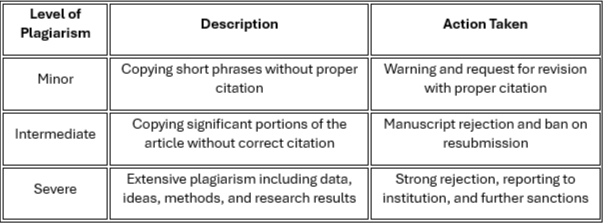
  1. Levels of Violation and Corresponding Actions


  1. Author Responsibilities
  • Authors are fully responsible for the originality of the submitted work.
  • Authors must ensure the manuscript has not been published previously or is under consideration elsewhere.
  • Authors are encouraged to perform plagiarism checks independently before submission.
  • Authors must ensure that all sources of data, references, and supporting materials are properly cited.
  1. Confidentiality and Integrity
  • The results of plagiarism checks are confidential and used solely by the editorial team for manuscript evaluation.
  • The journal is committed to maintaining scientific integrity and enforcing strict sanctions against plagiarism violations.
  • Any ethical misconduct identified after publication may result in correction, retraction, or removal of the article in accordance with international publication ethics standards.

This policy is designed to maintain publication quality, scientific credibility, and the integrity of research in medical records, health information management, and electronic health information systems. It also protects intellectual property rights and promotes ethical scholarly communication.