Screaning Plagiarism

The editorial team of Dentistry, Oral Knowledge, and Therapeutic Education Research acknowledges that plagiarism is unacceptable and establishes the following policy to define the procedures and actions to be taken when plagiarism is identified in a manuscript submitted for publication.

Plagiarism Policy:

  1. Purpose of Plagiarism Screening
    Plagiarism screening is conducted to ensure that every manuscript submitted to the journal is original, free from plagiarism, and compliant with the ethical standards of scientific publication in dentistry, oral health, and dental education.
  2. Plagiarism Checking Procedure
  • Every submitted manuscript may be screened using reliable plagiarism detection software, such as Turnitin, iThenticate, or other appropriate plagiarism detection tools.
  • The screening is conducted by the journal's editorial team during the initial assessment, before the manuscript proceeds to the peer review stage.
  • The editorial team evaluates the similarity report carefully to distinguish legitimate similarities, such as references and commonly used terminology, from potential plagiarism.
  1. Maximum Similarity Threshold
  • The submitted manuscript must have a maximum similarity index of 25%.
  • Manuscripts exceeding this threshold may be returned to the authors for revision or rejected, depending on the extent and nature of the similarities identified.
  • A similarity index below 25% does not automatically guarantee acceptance if plagiarism, unattributed borrowing, or other forms of academic misconduct are identified.
  1. Definition of Plagiarism
  • Plagiarism refers to the use of another person's words, ideas, data, images, research methods, or findings without appropriate acknowledgment or citation, whether intentional or unintentional.
  • Plagiarism includes copying text without proper attribution, presenting another person's ideas as one's own, reusing figures or tables without appropriate acknowledgment or permission where required, and paraphrasing sources without proper citation.
  • Self-plagiarism or redundant publication may also be considered an ethical violation when previously published material is reused without appropriate acknowledgment or disclosure.
  1. Levels of Violation and Corresponding Actions

The editorial team determines the appropriate action based on the extent of similarity, the nature of the material involved, the presence or absence of proper citation, and the author's response. Possible actions include requesting revisions, rejecting the manuscript, or taking further corrective measures when necessary.
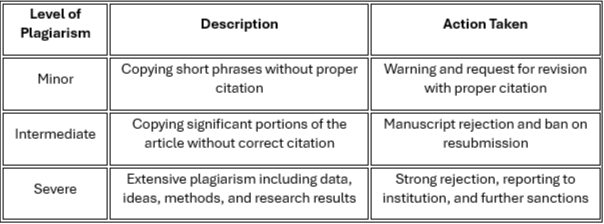
Levels of plagiarism violations and corresponding actions

  1. Author Responsibilities
  • Authors are fully responsible for ensuring the originality and integrity of their submitted manuscripts.
  • Authors must ensure that the manuscript has not been published previously and is not under consideration by another journal at the same time.
  • All sources, quotations, data, figures, tables, and other materials obtained from external sources must be properly acknowledged and cited.
  • Authors are encouraged to check their manuscripts for potential plagiarism before submission and to revise any inappropriate similarities.
  • Authors must cooperate with the editorial team in providing clarification or making corrections when potential plagiarism is identified.
  1. Confidentiality and Publication Integrity
  • Plagiarism screening reports and related editorial assessments are treated confidentially and used for manuscript evaluation and publication ethics procedures.
  • The journal is committed to protecting intellectual property rights, maintaining academic integrity, and addressing suspected plagiarism fairly and consistently.
  • Any suspected ethical violation is assessed by the editorial team, and appropriate action is taken based on the available evidence and the journal's publication ethics policies.

Through this plagiarism policy, Dentistry, Oral Knowledge, and Therapeutic Education Research aims to maintain the quality, credibility, and originality of scientific publications while protecting intellectual property rights and promoting responsible scholarly communication in dentistry, oral health, and dental education.