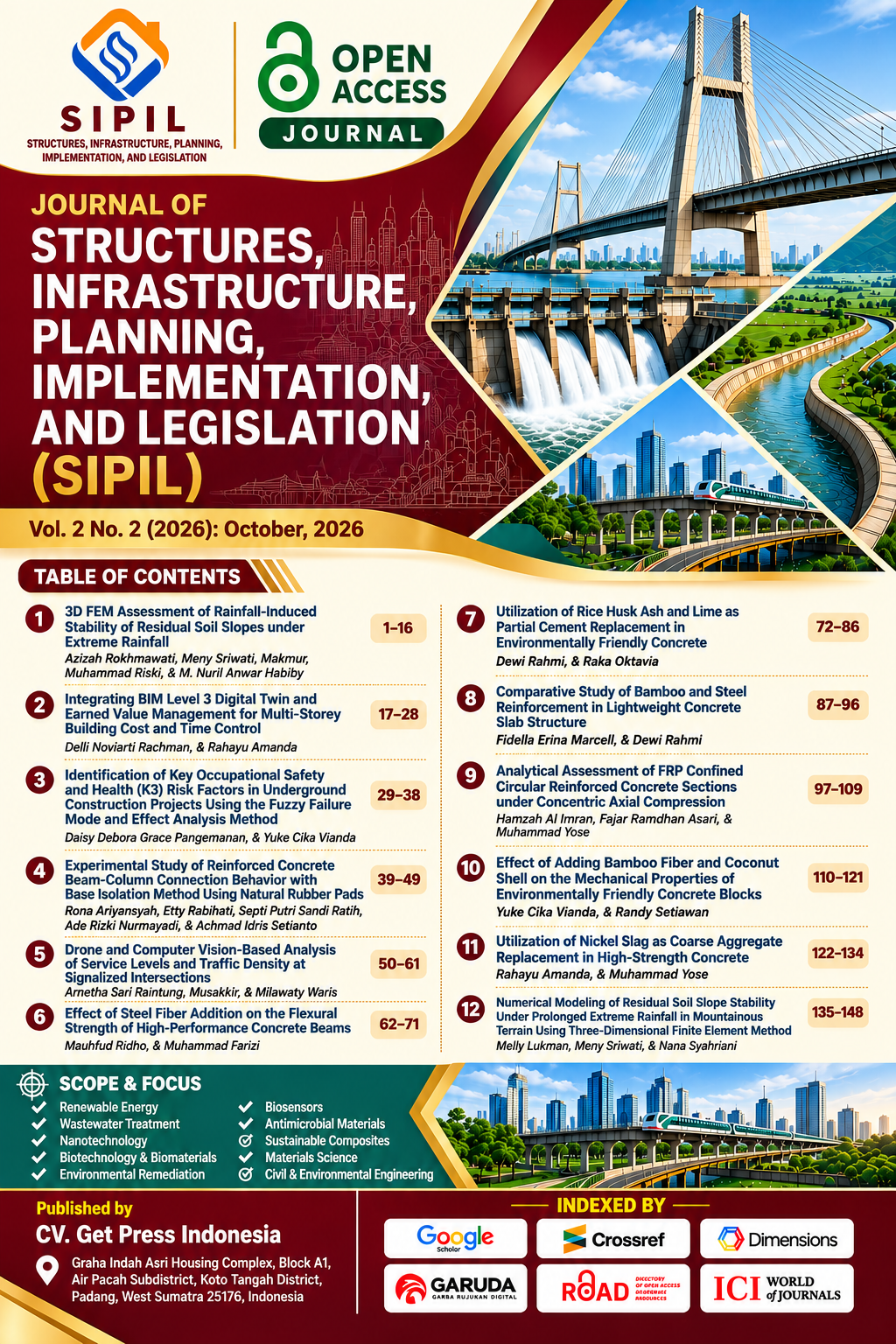
Integrating BIM Level 3 Digital Twin and Earned Value Management for Multi-Storey Building Cost and Time Control
DOI:
https://doi.org/10.69855/sipil.v2i2.701Keywords:
Building Information Modeling, BIM Level 3, Digital Twin, Earned Value Management, Cost Control, Schedule Performance, Multi-Storey BuildingAbstract
Cost overruns and schedule delays persist in multi-storey building construction, where project control often relies on periodic manual progress assessment and spreadsheet-based Earned Value Management (EVM). This study develops an integrated framework combining BIM Level 3 (digital twin) with EVM to improve the accuracy and timeliness of cost and schedule monitoring. The framework was applied to a 12-storey reinforced-concrete office tower in Padang City, West Sumatra (budget IDR 78.5 billion, planned duration 78 weeks). A federated IFC model was synchronized with as-built data from terrestrial laser scanning, RFID tags, and progress cameras to compute Earned Value automatically, and was compared with conventional manual EVM at eight control points against an independent verified quantity survey. The digital-twin approach reduced the mean absolute percentage error of progress measurement from 11.1% to 1.4%, shortened the reporting cycle from about 120 to 4 hours, and detected the adverse cost trend about 35 weeks earlier. Early detection enabled corrective action that limited the final cost overrun to 3.8% of the budget, against 11.2% forecast under conventional monitoring. Integrating BIM Level 3 digital twins with EVM therefore provides a more accurate, timely, and actionable basis for cost and schedule control.
References
A comprehensive framework for evaluating bridge project rework through earned value management (EVM) and building information modeling (BIM). (2026). Scientific Reports, 16. https://doi.org/10.1038/s41598-025-27546-0
Abumoeilak, L., Beheiry, S., & Atabay, S. (2025). An integrated decision support system for BIM Level 3 implementation. Frontiers in Built Environment, 11, 1687407. https://doi.org/10.3389/fbuil.2025.1687407
Alnaser, A. A., Ali, A. H., Elmousalami, H. H., & Elyamany, A. (2024). Assessment framework for BIM-digital twin readiness in the construction industry. Buildings, 14(1), 268. https://doi.org/10.3390/buildings14010268
Avvir. (2023). Maximize efficiency with earned value management systems. Avvir Construction Technology Insights.
Baghdadi, A. (2025). A comprehensive review of digital twin implementation in construction: Current trends and future directions. Journal of Asian Architecture and Building Engineering. https://doi.org/10.1080/13467581.2025.2517242
Bejarano, E. (2019). Integration of Earn Value Management into BIM projects. Journal of Architectural Engineering Technology, 7(2), 221. https://doi.org/10.4172/2168-9717.1000221
Cárdenas, R., Zapata, P., & Lozano, N. (2018). Building Information Modeling 5D and Earned Value Management methodologies integration through a computational tool. Revista Ingeniería de Construcción, 33(3), 263–278. https://doi.org/10.4067/S0718-50732018000300263
Deng, H., Hong, H., Luo, D., Deng, Y., & Su, C. (2020). Automatic indoor construction process monitoring for tiles based on BIM and computer vision. Journal of Construction Engineering and Management, 146(1). https://doi.org/10.1061/(ASCE)CO.1943-7862.0001744
Deng, M., Menassa, C. C., & Kamat, V. R. (2021). From BIM to digital twins: A systematic review of the evolution of intelligent building representations in the AEC-FM industry. Journal of Information Technology in Construction (ITcon), 26, 58-83.
Earned Value Management in construction: A review of current practices. (2025). Preprint / working paper.
Integration of Earn Value Management into BIM projects. (2019). Journal of Architectural Engineering Technology, 8(1).
Jiang, Y., et al. (2024). Building information models to robot-ready site digital twins: An agentic AI safety-first framework. arXiv preprint. https://arxiv.org/abs/2509.20705
Kavaliauskas, P., Fernandez, J. B., McGuinness, K., & Jurelionis, A. (2022). Automation of construction progress monitoring by integrating 3D point cloud data with an IFC-based BIM model. Buildings, 12(10), 1754. https://doi.org/10.3390/buildings12101754
Lee, J.-S., Hwang, H., & Choi, J. (2026). Process–cost integrated management and data utilization based on OpenBIM. Applied Sciences, 16(5), 2547. https://doi.org/10.3390/app16052547
Lehtola, V. V., Koeva, M., Elberink, S. O., Raposo, P., Virtanen, J. P., Vahdatikhaki, F., & Borsci, S. (2022). Digital twin of a city: Review of technology serving city needs. International Journal of Applied Earth Observation and Geoinformation, 114, 102915. https://doi.org/10.1016/j.jag.2022.102915
Long, W., Bao, Z., Chen, K., Ng, S. T., & Wuni, I. Y. (2024). Developing an integrative framework for digital twin applications in the building construction industry: A systematic literature review. Advanced Engineering Informatics, 59, 102346. https://doi.org/10.1016/j.aei.2023.102346
Lu, Q., Xie, X., Heaton, J., Parlikad, A. K., & Schooling, J. (2020). From BIM towards digital twin: Strategy and future development for smart asset management. In Service Oriented, Holonic and Multi-Agent Manufacturing Systems for Industry of the Future (pp. 392-404). Springer.
Lu, Q., Xie, X., Parlikad, A. K., Schooling, J. M., & Konstantinou, E. (2020). Moving from building information models to digital twins for operation and maintenance. Proceedings of the Institution of Civil Engineers - Smart Infrastructure and Construction, 174(2), 46-56. https://doi.org/10.1680/jsmic.20.00011
Megahed, N. A., & Hassan, A. M. (2022). Evolution of BIM to DTs: A paradigm shift for the post-pandemic AECO industry. Urban Science, 6(4), 67. https://doi.org/10.3390/urbansci6040067
Meyer, T., Brunn, A., & Stilla, U. (2022). Change detection for indoor construction progress monitoring based on BIM, point clouds and uncertainties. Automation in Construction, 141, 104442. https://doi.org/10.1016/j.autcon.2022.104442
Mohammadi, M., Rashidi, M., Yu, Y., & Samali, B. (2023). Integration of TLS-derived Bridge Information Modeling (BrIM) with a Decision Support System (DSS) for digital twinning and asset management of bridge infrastructures. Computers in Industry, 147, 103881. https://doi.org/10.1016/j.compind.2023.103881
Nguyen, T. D., & Adhikari, S. (2026). Advancing digital twins for building lifecycle management in construction: A systematic literature review. Buildings, 16(6), 1151. https://doi.org/10.3390/buildings16061151
Ozturk, G. B. (2021). Digital twin research in the AECO-FM industry. Journal of Building Engineering, 40, 102730. https://doi.org/10.1016/j.jobe.2021.102730
Process-cost integrated management and data utilization based on OpenBIM. (2026). Applied Sciences, 16(5), 2547. https://doi.org/10.3390/app16052547
Rehman, A., & Kim, S. (2025). Simulation-based validation of an integrated 4D/5D digital-twin framework for predictive construction control. arXiv preprint. https://arxiv.org/abs/2511.03684
Rincon, S. et al. (2019). Building Information Modeling 5D and Earned Value Management methodologies integration through a computational tool (COST-BIM). Revista Ingenieria de Construccion.
Tuhaise, V. V., Tah, J. H. M., & Abanda, F. H. (2023). Technologies for digital twin applications in construction. Automation in Construction, 152, 104931. https://doi.org/10.1016/j.autcon.2023.104931
Tuhaise, V. V., Tah, J. H. M., & Abanda, F. H. (2023). Technologies for digital twin applications in construction. Automation in Construction, 152, 104931. https://doi.org/10.1016/j.autcon.2023.104931
Turkan, Y., Bosché, F., Haas, C. T., & Haas, R. (2012). Automated progress tracking using 4D schedule and 3D sensing technologies. Automation in Construction, 22, 414–421. https://doi.org/10.1016/j.autcon.2011.10.003
Wu, H., Zeng, Z., Peng, Y., Yang, Q., Deng, H., Yu, J., & Zhou, P. (2026). From BIM to digital twin: A data-driven closed-loop framework for dynamic construction progress management. Buildings, 16(9), 1788. https://doi.org/10.3390/buildings16091788
Downloads
Published
How to Cite
Issue
Section
License
Copyright (c) 2026 Structures, Infrastructure, Planning, Implementation, and Legislation

This work is licensed under a Creative Commons Attribution 4.0 International License.