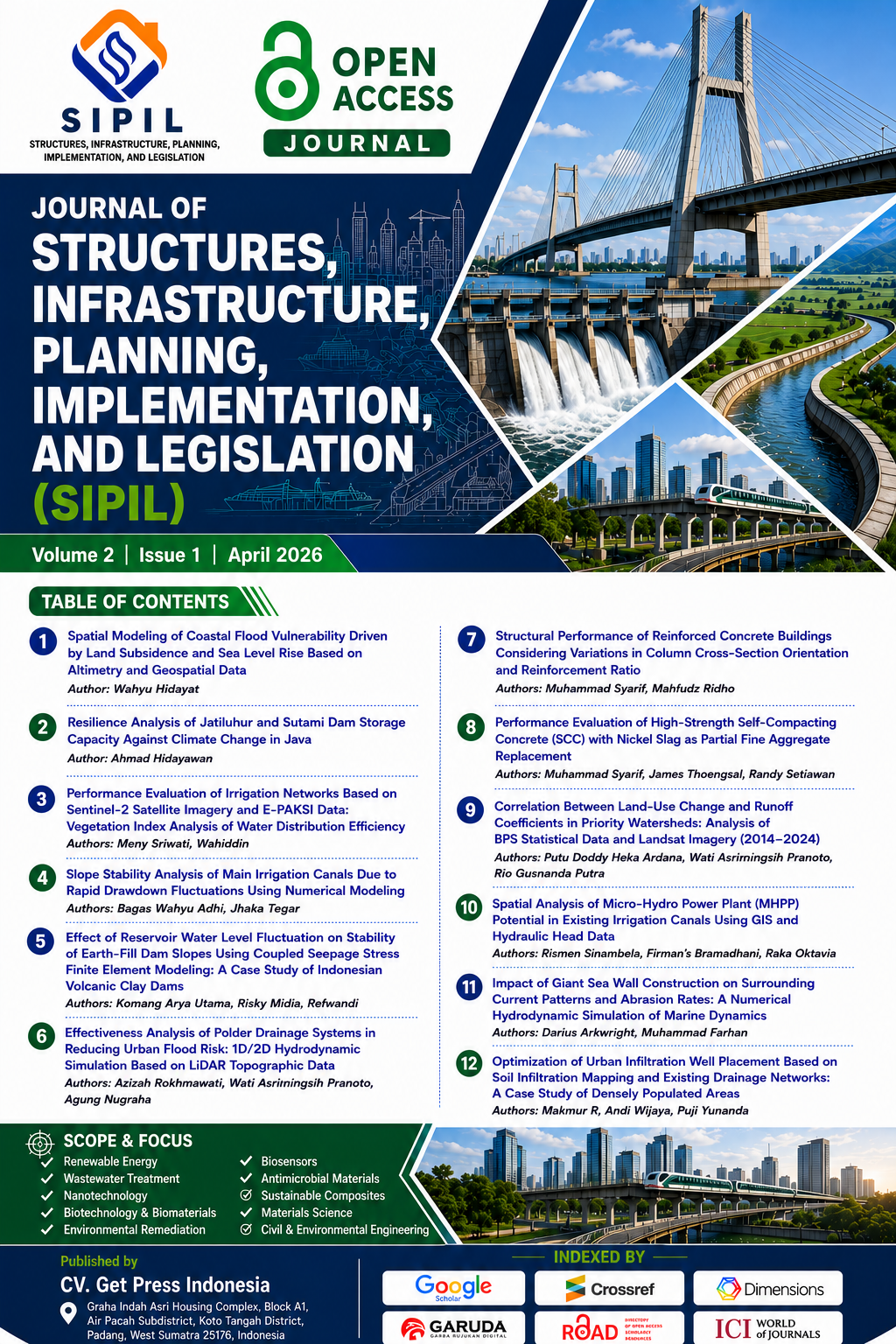
Performance Evaluation of High-Strength Self-Compacting Concrete (SCC) with Nickel Slag as Partial Fine Aggregate Replacement
DOI:
https://doi.org/10.69855/sipil.v2i1.531Keywords:
High-Strength Concrete, nickel slag, Self-Compacting Concrete, Sustainable Construction, Waste Upcycling, Structural PerformanceAbstract
The escalating demand for high-performance construction materials has intensified the search for sustainable alternatives to natural aggregates, particularly in the production of High-Strength Self-Compacting Concrete (SCC). This study evaluates the integration of nickel slag from Morowali, Central Sulawesi, as a partial replacement for fine aggregates to address the environmental degradation caused by river sand mining. Utilizing a quantitative experimental design, 48 cylindrical specimens were tested across various substitution levels (0%, 20%, 40%, and 60%) with a consistent water-to-binder ratio of 0.28 and a target characteristic strength of 60 MPa. Rheological parameters were assessed through slump-flow and L-box blocking ratio ( ) tests, while mechanical performance was measured via compressive strength at 7, 14, and 28 days. Results indicate that a 40% substitution threshold represents the optimum balance, yielding a superior characteristic strength of 69.73 MPa a 16.6% enhancement over the control. Rheologically, nickel slag improved fluidity up to 710 mm, although replacements exceeding 40% triggered dynamic instability and segregation, evidenced by an ratio decline to 0.78. These findings imply that nickel slag is a technically viable reinforcing filler for strategic infrastructure, provided that substitution levels are strictly calibrated. The study concludes that while nickel slag significantly densifies the concrete matrix, industrial adoption requires further standardization of long-term durability metrics. Future research should prioritize the evaluation of creep and chloride resistance in marine environments to ensure structural longevity.
References
Ahmad, M., Usman, M., & Al-Fakih, A. (2021). Mechanical and durability properties of self-compacting concrete containing industrial waste materials as fine aggregate replacement. Materials, 14(18), 5234.
American Society for Testing and Materials (ASTM). (2020). Standard Specification for Concrete Aggregates (ASTM C33/C33M-18). ASTM International.
Center for Mineral, C. a. (2023). Indonesian Mining Statistics: Nickel Sector and Byproducts. Ministry of Energy and Mineral Resources.
Center for Mineral, Coal, and Geothermal Resources. (2022). Indonesia Mineral Yearbook 2021. Ministry of Energy and Mineral Resources.
Das, S. K., Singh, S. K., & Das, S. C. (2021). Utilization of nickel slag in concrete: A review on its properties and environmental impact. Journal of Cleaner Production, Elsevier.
Kim, H. K., Lee, H. K., & Park, S. M. (2022). Recycling of ferronickel slag for sustainable concrete production: Engineering performance and environmental assessment. Resources, Conservation and Recycling, 181.
Li, J., Zhang, Z., & Chen, Y. (2022). Durability performance of self-compacting concrete incorporating industrial by-products. Construction and Building Materials, 325.
Ministry of Environment and Forestry. (2021). Government Regulation Number 22 of 2021 concerning the Implementation of Environmental Protection and Management. Indonesia: State Secretariat of the Republic of Indonesia.
Rahman, M. A., Karim, M. R., & Islam, M. S. (2023). Effect of nickel slag aggregate on workability, compressive strength, and durability of self-compacting concrete. Case Studies in Construction Materials, 18.
Repository, Z. (2024). Dataset on Compressive Strength and Porosity of Slag-Based High-Performance Concrete. European Organization for Nuclear Research.
Saha, A. K., & Sarker, P. K. (2020). Sustainable use of ferronickel slag fine aggregate in self-compacting concrete. Journal of Materials in Civil Engineering, 32(7).
Singh, N., & Choudhary, R. (2022). Performance of self-compacting concrete with industrial waste as aggregate: A systematic review. Construction and Building Materials, 318.
Wang, Y., Chen, P., & Gu, L. (2023). Influence of nickel slag on the rheological and mechanical properties of high-performance concrete. Materials Today Communications, 34.
Works, S. R. (2023). Technical Guidelines for Using Industrial Waste in Road and Bridge Construction. BPSDM PUPR.
Zhang, H., Wang, L., & Zhao, J. (2021). Compatibility between polycarboxylate superplasticizer and industrial by-product aggregates in SCC. Cement and Concrete Composites, 118.
Downloads
Published
How to Cite
Issue
Section
License
Copyright (c) 2026 Structures, Infrastructure, Planning, Implementation, and Legislation

This work is licensed under a Creative Commons Attribution 4.0 International License.