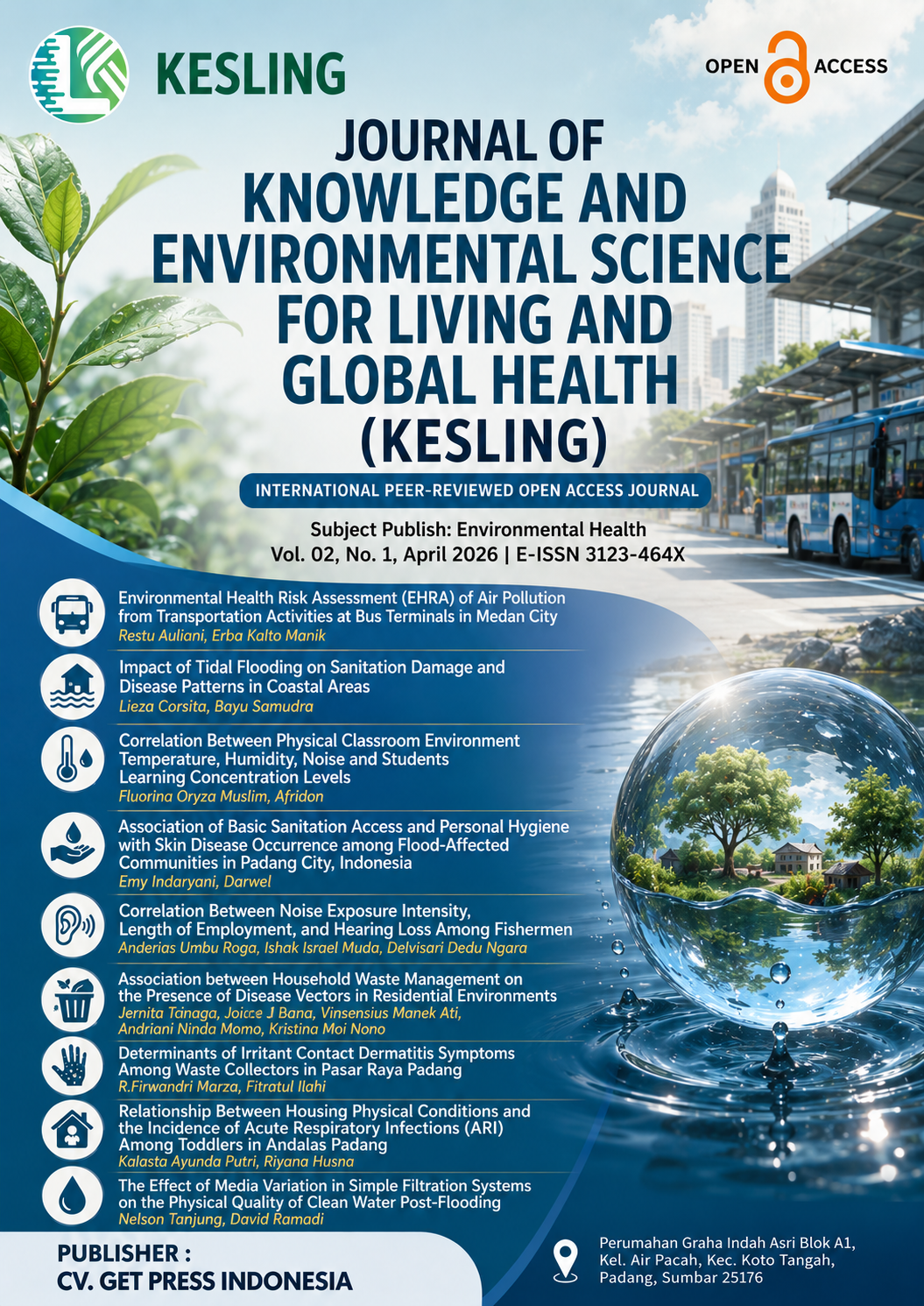
The Effect of Media Variation in Simple Filtration Systems on the Physical Quality of Clean Water Post-Flooding
DOI:
https://doi.org/10.69855/kesling.v2i1.664Keywords:
Post-Flood Water, Simple Filtration, Turbidity, Total Suspended Solids, Environmental HealthAbstract
Flooding is one of the most common disasters in Indonesia and often causes deterioration in clean water quality, particularly through increased turbidity, color, and suspended solids. One alternative for improving post-flood water quality is the use of simple filtration systems with different filter media combinations. This study aimed to analyze the effect of filtration media variations on the physical quality of post-flood water. An experimental study using a Completely Randomized Design (CRD) was conducted with four treatments and three replications. Water samples were collected from flood-affected areas in Padang City, West Sumatra, Indonesia. The treatments consisted of P0 (control), P1 (sand and gravel), P2 (sand, gravel, and activated carbon), and P3 (sand, gravel, activated carbon, and zeolite). The observed parameters included turbidity, color, and Total Suspended Solids (TSS). Data were analyzed using One-Way Analysis of Variance (ANOVA) at a 95% confidence level. The results showed that variations in filtration media significantly affected turbidity, color, and TSS (p < 0.05). Descriptively, treatment P3 showed the lowest mean values of turbidity (7.8 NTU), color (11.7 TCU), and TSS (12.0 mg/L) among all treatments. However, because no post hoc analysis was performed, these findings should not be interpreted as evidence that P3 was statistically superior to the other treatment combinations. The values obtained in P3 met the applicable water quality standards for all observed physical parameters. It can be concluded that variations in filtration media significantly influence the physical quality of post-flood water, and a filtration system combining sand, gravel, activated carbon, and zeolite has potential as an appropriate technology for post-disaster clean water provision.
References
Ahamad, T, Naushad, M, Al-Hokbany, N & Al-Saeedi, SI 2023, ‘Recent advances in low-cost filtration technologies for drinking water treatment’, Journal of Water Process Engineering, vol. 53, article 103715.
American Public Health Association (APHA) 2023, Standard Methods for the Examination of Water and Wastewater, 24th edn, American Public Health Association, Washington DC.
Azzouz, A, Ballesteros, E & Souhail, B 2024, ‘Natural zeolite applications in sustainable water treatment technologies: Recent developments and future perspectives’, Environmental Science and Pollution Research, vol. 31, no. 4, pp. 5120–5138.
Bhatnagar, A & Sillanpää, M 2017, ‘A review of emerging adsorbents for nitrate removal from water’, Chemical Engineering Journal, vol. 168, no. 2, pp. 493–504.
Crittenden, JC, Trussell, RR, Hand, DW, Howe, KJ & Tchobanoglous, G 2017, MWH's Water Treatment: Principles and Design, 3rd edn, John Wiley & Sons, New Jersey.
Effendi, H 2016, Water Quality Study for Aquatic Resources and Environmental Management, Kanisius, Yogyakarta.
Laily, NF, Nurhayati & Kusdiyantini, E 2022, ‘Improving the water quality of the Diponegoro Reservoir in Semarang with an activated charcoal filter’, Jurnal Penelitian Saintek, vol. 27, no. 1, pp. 1–10.
Mishra, S, Tiwari, A & Sharma, R 2021, ‘Performance evaluation of household filtration media for improving drinking water quality’, Environmental Technology & Innovation, vol. 24, pp. 101–112.
Nurhady, MF, Ramlan, D & Suparmin 2022, ‘The effect of filtration media thickness as water treatment on the turbidity and odor of dug well water in Kragilan Village, Kragilan District, Serang Regency in 2022’, Buletin Keslingmas, vol. 41, no. 3, pp. 137–143.
Regulation of the Minister of Health of the Republic of Indonesia Number 2 of 2023 concerning Implementing Regulations of Government Regulation Number 66 of 2014 concerning Environmental Health.
Puspa, FZ 2022, ‘Performance of zeolite adsorbent to improve water quality in ex-tin mine pits’, Jurnal Sains dan Teknologi, vol. 12, no. 2, pp. 327–338.
Sarkar, S, Roy, A & Ghosh, S 2022, ‘Application of natural filtration media for sustainable drinking water treatment: A review’, Environmental Technology Reviews, vol. 11, no. 1, pp. 140–158.
Tiwari, A, Mishra, S & Kumar, V 2021, ‘Application of natural filtration media for household water treatment in disaster-affected areas’, Journal of Water and Health, vol. 19, no. 4, pp. 612–621.
Law of the Republic of Indonesia Number 17 of 2019 concerning Water Resources.
World Health Organization (WHO) & United Nations Children's Fund (UNICEF) 2023, Progress on Household Drinking Water, Sanitation and Hygiene 2000–2022: Special Focus on Gender, WHO and UNICEF, Geneva.
World Health Organization (WHO) 2022, Guidelines for Drinking-Water Quality, 4th edn incorporating the first and second addenda, WHO, Geneva.
Downloads
Published
How to Cite
Issue
Section
License
Copyright (c) 2026 Knowledge and Environmental Science for Living and Global Health

This work is licensed under a Creative Commons Attribution 4.0 International License.