
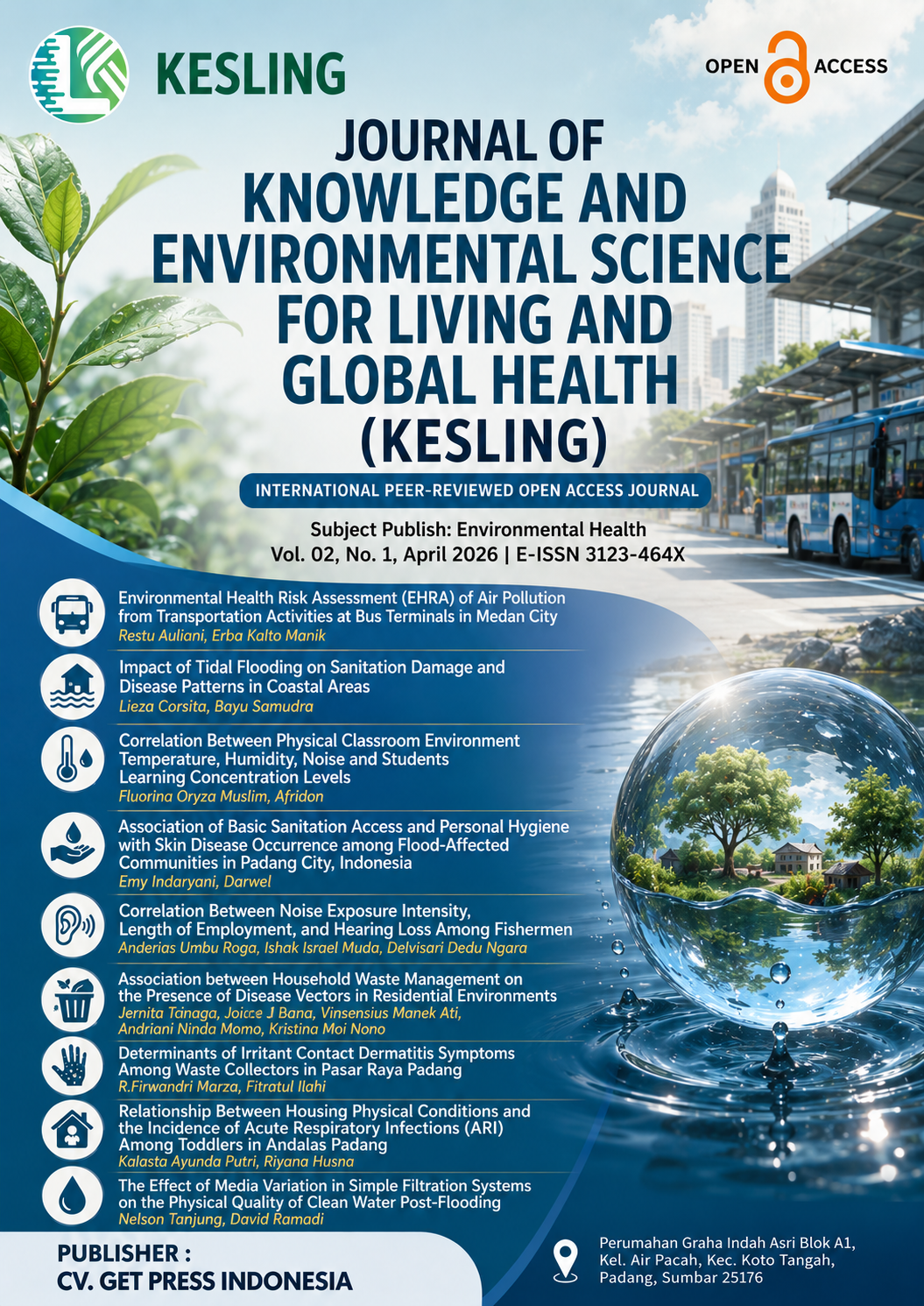
Relationship Between Housing Physical Conditions and the Incidence of Acute Respiratory Infections (ARI) Among Toddlers in Andalas Padang
DOI:
https://doi.org/10.69855/kesling.v2i1.653Keywords:
ARI, Toddlers, Housing Physical Conditions, Environmental HealthAbstract
Acute Respiratory Infection (ARI) remains a major health problem among children under five in Indonesia, including in Padang City. Poor housing physical conditions such as inadequate ventilation, insufficient natural lighting, high residential density, and improper humidity levels may increase the risk of ARI among toddlers. This study aimed to determine the relationship between housing physical conditions and the incidence of ARI among toddlers in Andalas Padang 2026. This study used an analytic observational design with a cross sectional approach. The study population consisted of mothers with toddlers aged 12–59 months in the Andalas, Padang City. A total of 80 respondents were selected using proportional random sampling technique. Data were collected through interviews, direct observation of housing conditions, and measurement of temperature, humidity, and lighting using environmental measuring instruments. Data were analyzed using univariate and bivariate analysis with the Chi-Square test at a 95% confidence level (α = 0.05). The results showed significant relationships between house ventilation (p-value = 0.004), natural lighting (p-value = 0.018), residential density (p-value = 0.001), and house humidity (p-value = 0.015) with the incidence of ARI among toddlers. Residential density was the variable most strongly associated with ARI incidence. In conclusion, housing physical conditions are associated with the incidence of ARI among toddlers. Therefore, efforts to improve healthy housing quality are needed to reduce ARI incidence among children under five
References
Afandi, A. I. (2012). The Relationship between Physical Environmental Conditions at Home and the Incidence of ISPA in Toddlers. Depok: Universitas Indonesia.
Cheni, A. R. (2024). The Effect of Indoor PM10 Concentration on the Incidence of ARI in Toddlers in Padang City. Padang: Fakultas Kesehatan Masyarakat.
Fakunle et al. (2021). Association of indoor microbial aerosols with respiratory symptoms among under-five children: A systematic review and meta-analysis. Environmental Health, 20(1), 77. doi:10.1186/s12940-021-00759-2
Febrianti. (2020). Incidence of ISPA in toddlers and home environmental factors. Jurnal Kesehatan Lingkungan Indonesia, 19(1), 45–52.
Handayani. (2016). Home Physical Environmental Risk Factors for the Incidence of ISPA in Toddlers. Depok: Universitas Indonesia.
Haryani et al. (2021). The influence of the physical environment of the home on the incidence of ARI in toddlers. Indonesian Journal of Midwifery, 4(1), 12–20.
Hidayanti, R., & Darwel, D. (2020). The relationship between the home environment and acute respiratory infections in toddlers in Padang City. Menara Ilmu, 14(2), 55–63.
Holden, e. a. (2023). The impact of poor housing and indoor air quality on respiratory health in children. Breathe, 19(2), 230058. doi:10.1183/20734735.0058-2023
Holden, K. A., Lee, A. R., Hawcutt, D. B., & Sinha, I. P. (2023). The impact of poor housing and indoor air quality on respiratory health in children. Breathe, 19(2), 230058. doi:10.1183/20734735.0058-2023
Indonesia, K. K. (2019). Indonesian Health Profile. Jakarta: Kementerian Kesehatan Republik Indonesia.
Indonesia, K. K. (2021). 2021 National Riskesdas Report. Jakarta: Kementerian Kesehatan Republik Indonesia.
Kristina. (2011). The Relationship Between the Physical Condition of the Home and the Incidence of ARI in Toddlers. Depok: Universitas Indonesia.
Rahmat. (2021). Increasing infant mortality rate due to ISPA in Indonesia. Jurnal Epidemiologi Kesehatan Indonesia, 5(2), 90–98.
Simkovich, S. M. (2019). The health and social implications of household air pollution and respiratory diseases. npj Primary Care Respiratory Medicine, 29(1), 12. doi:10.1038/s41533-019-0126-x
Wardani, I., & Astuti, D. (2021). Literature review on physical home environmental factors related to the incidence of ARI in toddlers. Environmental Occupational Health and Safety Journal, 2(2), 134–142.
Wimalasena, N. N., Chang-Richards, A., Wang, K. I., & Dirks, K. N. (2021). Housing risk factors associated with respiratory disease: A systematic review. International Journal of Environmental Research and Public Health, 18(6), 2815. doi:10.3390/ijerph18062815
Yulia, Y., Awalia, F., & Suharno, S. (2024). The relationship between the physical environment of the home and PHBS with the incidence of ISPA in toddlers. Jurnal Kesehatan Lingkungan Mapaccing, 2(1), 33–41.
Downloads
Published
How to Cite
Issue
Section
License
Copyright (c) 2026 Knowledge and Environmental Science for Living and Global Health

This work is licensed under a Creative Commons Attribution 4.0 International License.