
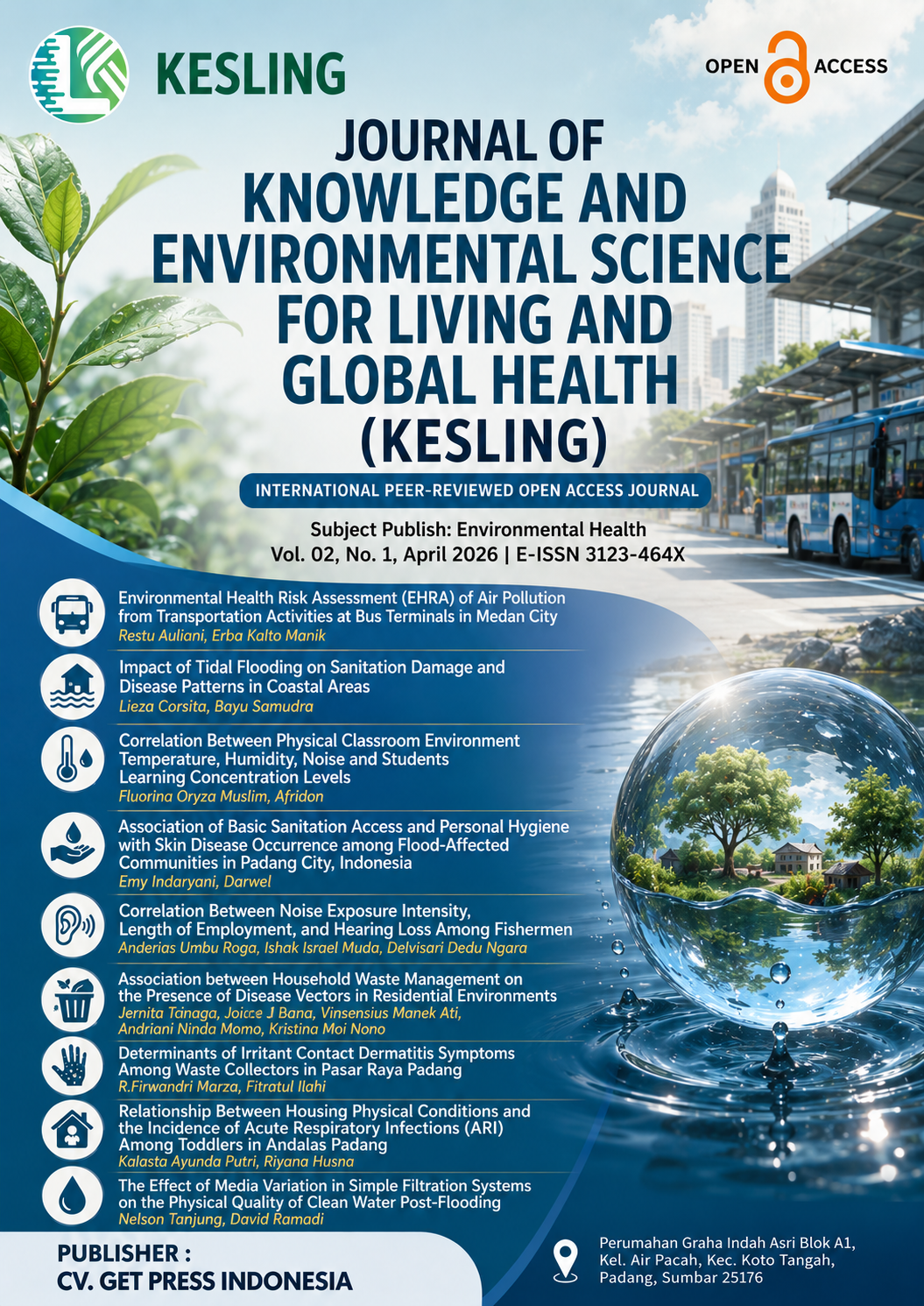
Determinants of Irritant Contact Dermatitis Symptoms Among Waste Collectors in Pasar Raya Padang
DOI:
https://doi.org/10.69855/kesling.v2i1.630Keywords:
Irritant Contact Dermatitis, Waste Collectors, Personal Protective Equipment, Personal Hygiene, Length of employmentAbstract
Irritant contact dermatitis is one of the most common occupational skin disorders among informal sector workers, including waste collectors who are routinely exposed to irritant materials. This study aimed to analyze factors associated with irritant contact dermatitis symptoms among waste collectors in Pasar Raya Padang. An analytical observational study with a cross-sectional design was conducted involving 75 respondents selected using a total sampling technique. Independent variables included duration of exposure, length of employment, personal hygiene, and use of personal protective equipment (PPE). Data were collected using structured questionnaires and direct observation, then analyzed using the chi-square test with a significance level of 0.05 and presented as odds ratios (OR). The results showed that 58.7% of respondents experienced dermatitis symptoms. Significant associations were found between length of employment (p=0.021; OR=3.10) and PPE use (p=0.013; OR=3.85) with dermatitis symptoms. Meanwhile, duration of exposure (p=0.642; OR=1.28) and personal hygiene (p=0.274; OR=1.54) were not significantly associated. Waste collectors with longer working periods and non-compliance with PPE use had a higher risk of experiencing dermatitis symptoms. In conclusion, length of employment and PPE use were significant factors associated with irritant contact dermatitis symptoms among waste collectors. Strengthening PPE compliance and occupational health education are recommended to reduce the risk of occupational skin disorders in informal sector workers.
References
Ambarsari, D. D., & Mulasari, S. A. (2018). Factors related to subjective complaints of irritant contact dermatitis in waste collectors in Yogyakarta City. Jurnal Kesehatan Lingkungan Indonesia, 17(2), 80–86. https://doi.org/10.14710/jkli.17.2.80-86
Behroozy, A., & Keegel, T. G. (2018). Wet-work exposure: A main risk factor for occupational hand dermatitis. Safety and Health at Work, 9(2), 175–180. https://doi.org/10.1016/j.shaw.2017.09.001
Creswell, J. W., & Creswell, J. D. (2018). Research design: Qualitative, quantitative, and mixed methods approaches (5th ed.). SAGE Publications
Etikan, I., & Bala, K. (2017). Sampling and sampling methods. Biometrics & Biostatistics International Journal, 5(6), 00149.
Fitriandini, L. L., Adriyani, R., & Akliyah, D. M. (2023). Personal hygiene, use of personal protective equipment, and the incidence of irritant contact dermatitis in waste collectors. Media Publikasi Promosi Kesehatan Indonesia, 7(5), 1041–1047. https://doi.org/10.56338/mppki.v7i5.5134
Hamnerius, N., Svedman, C., Bergendorff, O., & Bruze, M. (2018). Wet work exposure and hand eczema among healthcare workers. Contact Dermatitis, 79(6), 321–329. https://doi.org/10.1111/cod.13066
Johansen, J. D., Mahler, V., Lepoittevin, J. P., Frosch, P. J., & Thyssen, J. P. (2022). Contact dermatitis: Causes, prevention, and management. The Lancet, 400(10364), 161–172. https://doi.org/10.1016/S0140-6736(22)01072-3
Kementerian Kesehatan Republik Indonesia. (2022). Indonesia's Health Profile 2022. Kemenkes RI. https://www.kemkes.go.id
Kementerian Lingkungan Hidup dan Kehutanan Republik Indonesia. (2021). Indonesian environmental statistics. KLHK RI.
Law of the Republic of Indonesia Number 1 of 1970 concerning Occupational Safety.
Levin, K. A. (2020). Study design III: Cross-sectional studies. Evidence-Based Dentistry, 7(1), 24–25.
Liu, X., et al. (2019). Occupational skin disease risk factors: A systematic review. International Journal of Environmental Research and Public Health, 16(20), 1–12. https://doi.org/10.3390/ijerph16203978
Nosbaum, A., Vocanson, M., Rozieres, A., Hennino, A., & Nicolas, J. F. (2020). Allergic and irritant contact dermatitis. European Journal of Dermatology, 30(3), 231–240. https://doi.org/10.1684/ejd.2020.3773
Pramana, I. G. S. A., & Utami, N. W. A. (2021). The relationship between personal hygiene and the use of personal protective equipment with dermatitis in waste workers. Archive of Community Health, 8(2), 155–164. https://doi.org/10.24843/ACH.2021.v08.i02.p09
Putri, A. R., & Rahman, F. (2021). Risk factors for skin disorders in waste management workers. Jurnal Kesehatan Lingkungan Indonesia, 20(2), 85–92.
Sari, D. P., et al. (2020). The relationship between exposure to waste and complaints of skin diseases in cleaning staff. Jurnal Kesehatan Masyarakat Nasional, 15(3), 123–130.
Setia, M. S. (2016). Methodology series module 3: Cross-sectional studies. Indian Journal of Dermatology, 61(3), 261–264.
Sudarmanto, S., & Nurjazuli, N. (2016). The relationship between the use of personal protective equipment and the incidence of skin diseases in waste transport workers. Jurnal Kesehatan Lingkungan Indonesia, 15(1), 6–9. https://doi.org/10.14710/jkli.15.1.6-9
Ulva, S. M. (2019). Factors associated with dermatitis in waste transport workers. Miracle Journal of Public Health, 3(1), 8–14. https://doi.org/10.36566/mjph/Vol3.Iss1/144
Wang, X., & Cheng, Z. (2020). Cross-sectional studies: Strengths, weaknesses, and recommendations. Chest, 158(1), S65–S71.
World Health Organization. (2021). Occupational health and safety statistics. WHO.
Downloads
Published
How to Cite
Issue
Section
License
Copyright (c) 2026 Knowledge and Environmental Science for Living and Global Health

This work is licensed under a Creative Commons Attribution 4.0 International License.