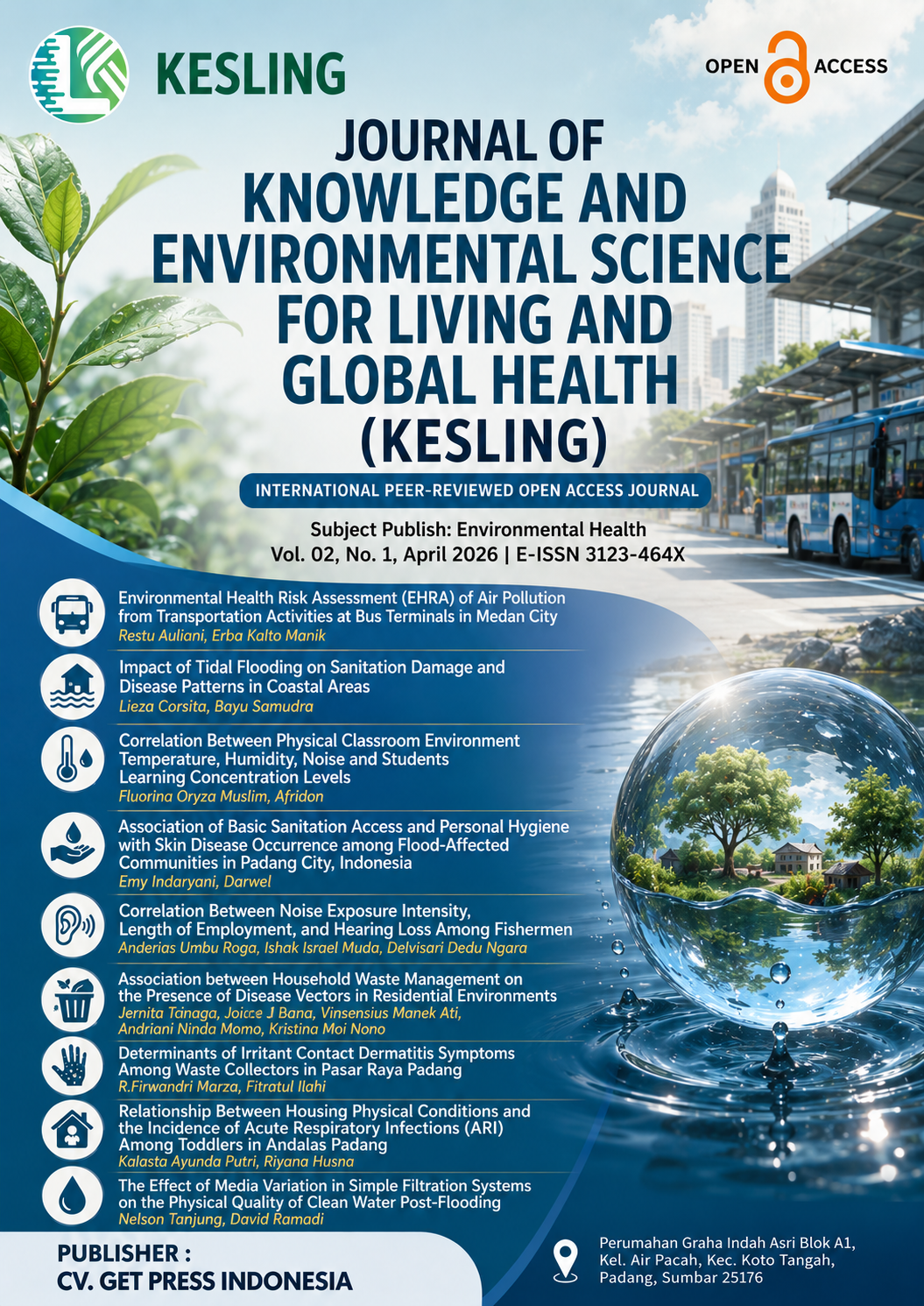
Environmental Health Risk Assessment (EHRA) of Air Pollution from Transportation Activities at Bus Terminals in Medan City
DOI:
https://doi.org/10.69855/kesling.v2i1.629Keywords:
Environmental Health Risk Assessment, Air Pollution, Bus Terminal, CO, PM2.5, MedanAbstract
Air pollution from transportation activities at bus terminals poses significant environmental health risks, particularly in densely populated urban areas. This study aims to assess the health risks associated with exposure to air pollutants among individuals working at bus terminals in Medan City, Indonesia. A quantitative descriptive approach using Environmental Health Risk Assessment (EHRA) was applied. Data were collected through direct measurements of carbon monoxide (CO), nitrogen dioxide (NO₂), and particulate matter (PM2.5), as well as interviews to determine exposure duration, frequency, and body weight. The study involved 60 respondents, including traders, drivers, and terminal officers. Risk characterization was conducted using the Risk Quotient (RQ). The results indicated that the concentrations of CO and PM2.5 exceeded WHO air quality standards during peak hours. The RQ values for a majority of respondents were greater than 1, indicating potential non-carcinogenic health risks. The highest risk was observed among traders due to prolonged exposure duration. These findings highlight the urgent need for emission control strategies, improved environmental management, and health protection measures for vulnerable populations. In conclusion, EHRA is an effective tool to evaluate environmental health risks in transportation hubs.
References
Abidin, M., et al. (2022). Air pollution exposure and respiratory health outcomes in urban populations. Environmental Research, 204, 112123. https://doi.org/10.1016/j.envres.2021.112123
Bootdee, S., et al. (2023). Urban air pollution exposure and human health risk assessment. International Journal of Technology, 14(1), 155–164. https://doi.org/10.14716/ijtech.v14i1
Donowati, M. P., & Kholmi, M. (2024). Analysis of air quality improvement at terminals: Strategies to reduce exhaust emissions from bus fleets. Innovative: Journal of Social Science Research, 4(3), 8773–8783. https://doi.org/10.31004/innovative.v4i3.11355
Irniza, R., et al. (2014). Air pollution exposure in transportation environments and associated health risks. Asian Journal of Environment-Behaviour Studies, 5(15), 1–10.
Kermani, M., et al. (2022). Traffic-related air pollution and its effects on urban environments. Sustainable Cities and Society, 76, 103441. https://doi.org/10.1016/j.scs.2021.103441
Kumar, P., Morawska, L., Martani, C., et al. (2023). Transport emissions and their impact on air quality and human health. Atmosphere, 14, 88. https://doi.org/10.3390/atmos14010088
Lemeshow, S., Hosmer, D. W., Klar, J., & Lwanga, S. K. (1990). Adequacy of sample size in health studies. World Health Organization.
Lubis, A. A., & Saraan, M. I. K. (2025). Analysis of the implementation of green transportation to realize a green and sustainable city (Study on the rapid transit bus transportation mode in Medan City). OPINI: Journal of Communication and Social Science, 2(1), 40–50. https://doi.org/10.70489/xpv69c44
Ministry of Environment and Forestry of Indonesia. (2021). Government Regulation No. 22 of 2021 on national ambient air quality standards. Ministry of Environment and Forestry of Indonesia.
Pangestika, D., Raharjo, B., et al. (2020). Health risk assessment of PM2.5 exposure in urban environments. Jurnal Kesehatan Lingkungan Indonesia, 19(1), 45–52. https://doi.org/10.14710/jkli.19.1.45-52
Rahmawati, S. (2023). Application of Environmental Health Risk Assessment (EHRA) in pollution studies. Jurnal Kesehatan Tropis, 11(2), 101–110.
Sari, N., et al. (2020). Environmental health risk assessment of air pollution exposure at bus terminals. Jurnal Kesehatan Lingkungan, 12(2), 78–85.
United States Environmental Protection Agency (US EPA). (2009). Risk assessment guidance for superfund (RAGS), Volume I: Human health evaluation manual (Part F). US EPA.
World Health Organization. (2021). WHO global air quality guidelines: Particulate matter (PM2.5 and PM10), ozone, nitrogen dioxide, sulfur dioxide and carbon monoxide. WHO. https://www.who.int/publications/i/item/9789240034228
Zhang, Y., et al. (2019). Exposure to PM2.5 and associated health risks: A global perspective. Science of the Total Environment, 650, 123–130. https://doi.org/10.1016/j.scitotenv.2018.09.089
Downloads
Published
How to Cite
Issue
Section
License
Copyright (c) 2026 Knowledge and Environmental Science for Living and Global Health

This work is licensed under a Creative Commons Attribution 4.0 International License.