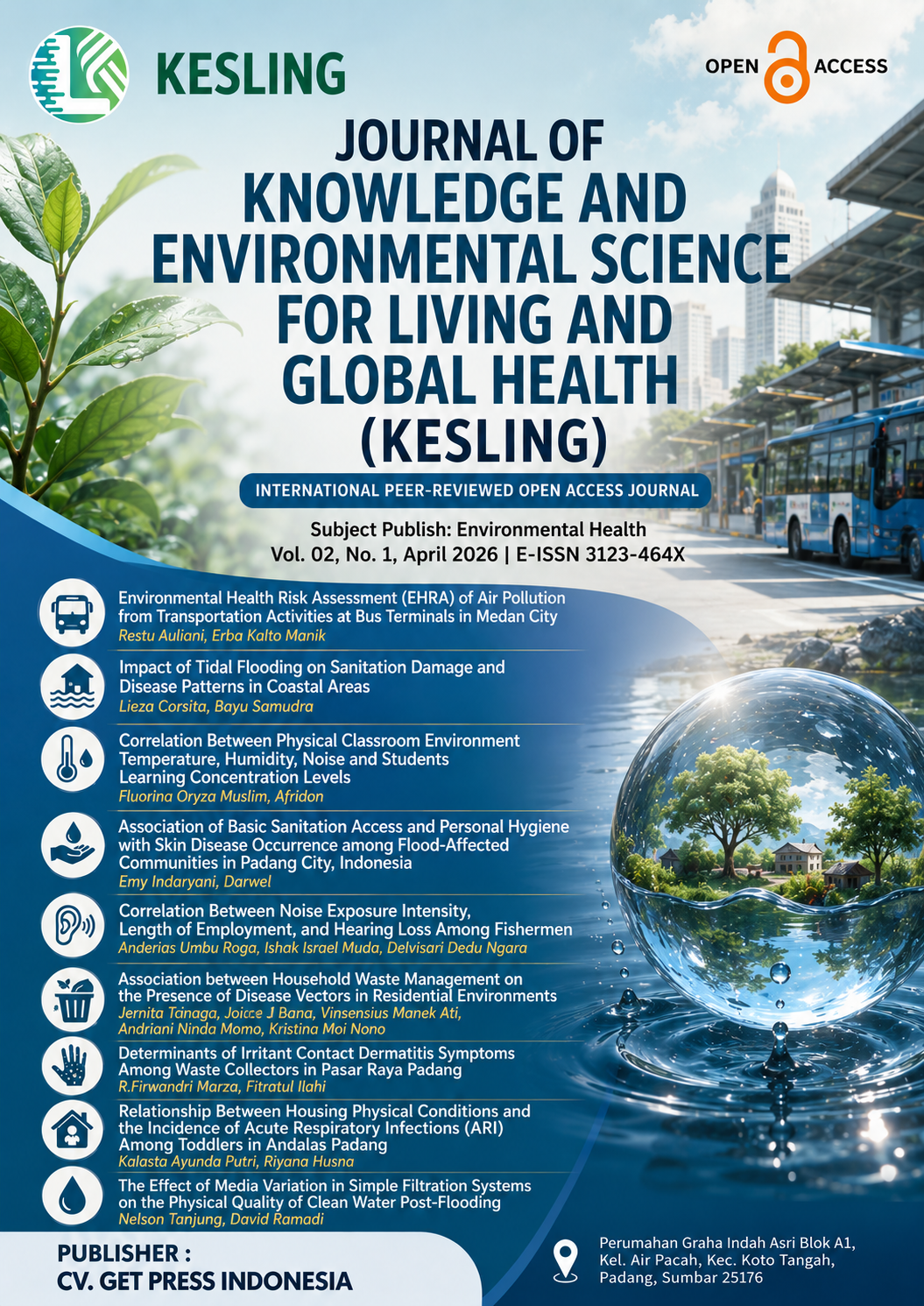
Association of Basic Sanitation Access and Personal Hygiene with Skin Disease Occurrence among Flood-Affected Communities in Padang City, Indonesia
DOI:
https://doi.org/10.69855/kesling.v2i1.615Keywords:
Basic Sanitation, Personal Hygiene, Skin Diseases, Flood, Environmental HealthAbstract
Flooding is a hydrometeorological disaster that increases the risk of skin diseases due to poor sanitation and inadequate personal hygiene. This study aimed to analyze the relationship between access to basic sanitation and personal hygiene with the occurrence of skin diseases among flood-affected communities in Padang City in 2025. A quantitative study with a cross-sectional design was conducted involving 150 respondents selected using simple random sampling. Data were collected through structured questionnaires and observations and analyzed using chi-square tests and logistic regression. The results showed that 62.7% of respondents experienced skin diseases. There were significant associations between access to basic sanitation (p = 0.003) and personal hygiene (p = 0.001) with the occurrence of skin diseases. Multivariate analysis indicated that inadequate sanitation was associated with a 2.4-times higher likelihood of skin diseases (OR = 2.40; 95% CI: 1.35–4.26), while poor personal hygiene was associated with a 3.1-times higher likelihood of skin diseases (OR = 3.10; 95% CI: 1.68–5.72). It was concluded that personal hygiene was the most dominant factor associated with the occurrence of skin diseases. Therefore, integrated hygiene-based interventions and the provision of adequate sanitation are important to reduce the risk of skin diseases among flood-affected communities.
References
Badan Nasional Penanggulangan Bencana. (2023). Indonesian disaster incident data. BNPB.
Cairncross, S., Bartram, J., Cumming, O., & Brocklehurst, C. (2021). Hygiene, sanitation, and water: What needs to be done? PLoS Medicine, 18(3), e1003618. doi:10.1371/journal.pmed.1003618
Casanova, L. M., Walters, A., & Naghshineh, N. (2020). Impact of flooding on skin and soft tissue infections. Journal of Water and Health, 18(4), 561-570. doi:10.2166/wh.2020.045
Dinas Kesehatan Kota Padang. (2024). Environmentally based disease incidence reports. Dinas Kesehatan Kota Padang.
Freeman, M. C., Garn, J. V., Sclar, G. D., & dst. (2017). The impact of sanitation on infectious disease and nutritional status: A systematic review and meta-analysis. International Journal of Hygiene and Environmental Health, 220(6), 928-949. doi:10.1016/j.ijheh.2017.05.007
Freeman, M. C., Stocks, M. E., Cumming, O., & dst. (2020). Systematic review: Hygiene and health outcomes in disaster settings. International Journal of Hygiene and Environmental Health, 227, 113512. doi:10.1016/j.ijheh.2020.113512
Kementerian Kesehatan Republik Indonesia. (2014). Minister of Health Regulation Number 3 of 2014 concerning Community-Based Total Sanitation. Kementerian Kesehatan Republik Indonesia.
Kementerian Kesehatan Republik Indonesia. (2021). Indonesia's health profile in 2021. Kementerian Kesehatan Republik Indonesia.
Kementerian Kesehatan Republik Indonesia. (2022). Indonesia's health profile in 2022. Kementerian Kesehatan Republik Indonesia.
Nurfajriyani, I., Sopandi, I., Fadilatussaniatun, Q., Yusup, I. R., & Kurniati, T. (2020). The influence of environmental sanitation and clean living behavior on the incidence of skin diseases in flood-affected communities. Jurnal Kesehatan Lingkungan Indonesia, 19(2), 85-92. doi:10.14710/jkli.19.2.85-92
Prüss-Ustün, A., Wolf, J., Bartram, J., & dst. (2019). Burden of disease from inadequate water, sanitation and hygiene. International Journal of Hygiene and Environmental Health, 222(5), 765-777. doi:10.1016/j.ijheh.2019.05.004
Putri, A. R., & Handayani, S. (2022). The relationship between personal hygiene and the incidence of dermatitis in communities in flood-prone areas. Jurnal Kesehatan Masyarakat Nasional, 17(1), 45-52. doi:10.21109/kesmas.v17i1.5678
Rahman, F., Yusuf, A., & Dewi, R. (2023). Behavioral factors and environmental sanitation on post-flood disaster skin diseases. Jurnal Promosi Kesehatan Indonesia, 18(1), 33-41. doi:10.14710/jpki.18.1.33-41
Republik Indonesia. (2023). Law Number 17 of 2023 concerning Health. Republik Indonesia.
Sari, N., Widodo, T., & Lestari, D. (2021). Basic sanitation and the incidence of skin diseases in urban flood-affected communities. Media Kesehatan Masyarakat Indonesia, 20(3), 210-217. doi:10.30597/mkmi.v20i3.13456
Sphere Association. (2021). The Sphere handbook: Humanitarian charter and minimum standards in humanitarian response. Sphere Association.
United Nations Children’s Fund (UNICEF). (2022). Water, sanitation and hygiene (WASH) in emergencies. UNICEF.
Wolf, J., Hunter, P. R., Freeman, M. C., & dst. (2018). Impact of drinking water, sanitation and handwashing with soap on childhood diarrhoeal disease: Updated meta-analysis and meta-regression. Tropical Medicine & International Health, 23(5), 508-525. doi:10.1111/tmi.13051
World Health Organization. (2020). Water, sanitation and hygiene strategy 2018–2025. WHO.
World Health Organization. (2021). Environmental health in emergencies and disasters: A practical guide. WHO.
Downloads
Published
How to Cite
Issue
Section
License
Copyright (c) 2026 Knowledge and Environmental Science for Living and Global Health

This work is licensed under a Creative Commons Attribution 4.0 International License.