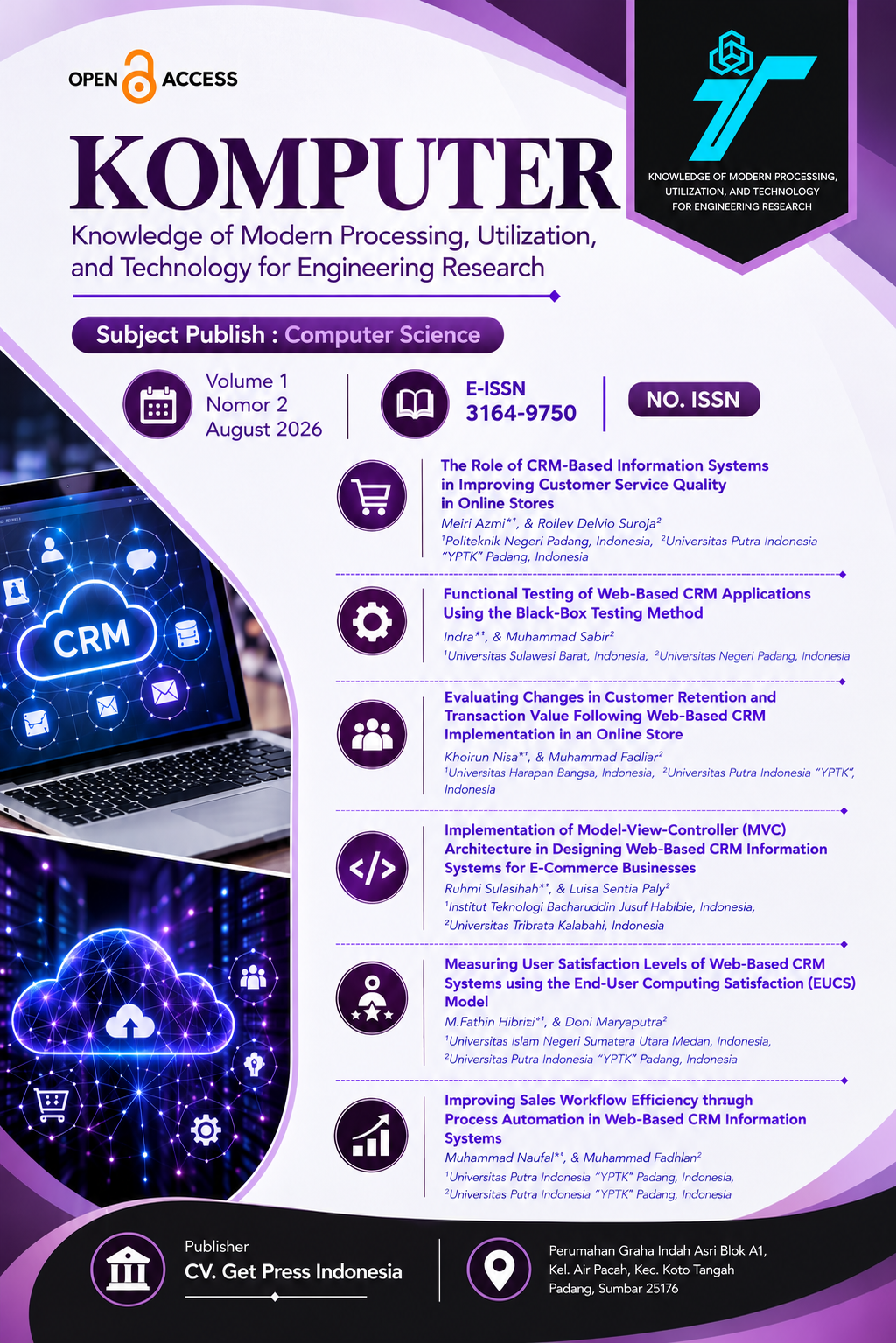
Improving Sales Workflow Efficiency through Process Automation in Web-Based CRM Information Systems
DOI:
https://doi.org/10.69855/komputer.v1i2.863Keywords:
CRM information system, Workflow automation, Process efficiency, Black-box testing, System Usability Scale, Rapid Application DevelopmentAbstract
Small and medium-sized enterprises frequently manage customer and sales data through manual, spreadsheet- and communication-app-based processes that are prone to delay, data inconsistency, and lost follow-up opportunities. This study designs, develops, and empirically evaluates a web-based Customer Relationship Management (CRM) information system with an integrated workflow automation layer, targeting eight core sales workflow tasks: lead data entry, lead assignment, follow-up scheduling, quotation generation, deal stage status update, approval routing, customer follow-up reminders, and monthly sales report generation. The system was developed using the Rapid Application Development (RAD) method and evaluated through three complementary testing approaches: black-box functional testing using the equivalence partitioning technique, System Usability Scale (SUS) usability assessment (n = 30 respondents), and a controlled process-time efficiency comparison between manual and automated task execution (n = 20 trials per task per condition, 160 paired observations in total). Black-box testing across seven system modules (76 test cases) achieved a 96.05% pass rate. The System Usability Scale assessment yielded a mean score of 80.75 (SD = 6.62), corresponding to an "Excellent" to "Good" usability grade and exceeding the commonly cited industry-average benchmark of 68. A paired-samples t-test comparing manual and automated task completion time across all 160 trials showed a highly significant reduction in process time (t(159) = 8.64, p < 0.001), with an overall time reduction of 82.17% across the eight measured tasks, ranging from 71.99% (quotation generation) to 87.09% (monthly sales report generation). These findings demonstrate that workflow automation integrated into a web-based CRM information system can substantially and measurably improve sales process efficiency while maintaining high functional reliability and user-perceived usability, offering an empirically validated reference architecture for small and medium enterprise sales digitalization.
References
Amalia, A., Hamidah, S. W. P., & Kristanto, T. (2021). Pengujian black box menggunakan teknik equivalence partitions pada aplikasi e-learning berbasis web. Building of Informatics, Technology and Science (BITS), 3(3), 269–274. https://doi.org/10.47065/bits.v3i3.1062
Anggraini, W., Candra, R. M., & Sari, W. U. (2020). Analisis sistem informasi akademik mahasiswa menggunakan metode System Usability Scale. Jurnal Penelitian Saintek, 25(2), 184–194. https://doi.org/10.21831/jps.v25i2.28763
Bangor, A., Kortum, P. T., & Miller, J. T. (2008). An empirical evaluation of the System Usability Scale. International Journal of Human-Computer Interaction, 24(6), 574–594. https://doi.org/10.1080/10447310802205776
Brooke, J. (1996). SUS: A quick and dirty usability scale. In P. W. Jordan, B. Thomas, B. A. Weerdmeester, & I. L. McClelland (Eds.), Usability evaluation in industry (pp. 189–194). Taylor & Francis.
Buttle, F., & Maklan, S. (2019). Customer relationship management: Concepts and technologies (4th ed.). Routledge.
Davis, F. D. (1989). Perceived usefulness, perceived ease of use, and user acceptance of information technology. MIS Quarterly, 13(3), 319–340. https://doi.org/10.2307/249008
DeLone, W. H., & McLean, E. R. (2003). The DeLone and McLean model of information systems success: A ten-year update. Journal of Management Information Systems, 19(4), 9–30. https://doi.org/10.1080/07421222.2003.11045748
Doll, W. J., & Torkzadeh, G. (1988). The measurement of end-user computing satisfaction. MIS Quarterly, 12(2), 259–274. https://doi.org/10.2307/248851
Hair, J. F., Hult, G. T. M., Ringle, C. M., Sarstedt, M., Danks, N. P., & Ray, S. (2021). Partial least squares structural equation modeling (PLS-SEM) using R: A workbook. Springer International Publishing.
Hanum, R., Fachrudin, D. H., & Rohyana, C. (2026). Rancang bangun sistem informasi UMKM berbasis web untuk promosi digital menggunakan metode Rapid Application Development (RAD). MALCOM: Indonesian Journal of Machine Learning and Computer Science.
Hanum, R., & Safitri, D. (2023). Penerapan metode Rapid Application Development dalam pengembangan sistem informasi penjualan berbasis web. Jurnal Teknologi Informasi dan Pendidikan, 16(1), 78–89.
Hewner, A. R., March, S. T., Park, J., & Ram, S. (2004). Design science in information systems research. MIS Quarterly, 28(1), 75–105. https://doi.org/10.2307/25148625
Jamil, M., & Ahmad, N. (2022). The impact of CRM system on customer satisfaction and loyalty: A study of Indonesian banking sector. Journal of Asian Finance, Economics and Business, 9(3), 245–254.
Kurniawan, D., & Wibowo, A. (2021). Evaluasi usability sistem informasi manajemen pelanggan menggunakan System Usability Scale. Jurnal Teknologi Informasi dan Pendidikan, 14(1), 45–56.
Lewis, J. R. (2018). The System Usability Scale: Past, present, and future. International Journal of Human-Computer Interaction, 34(7), 577–590. https://doi.org/10.1080/10447318.2018.1455307
Mahendra, G. S., & Asmarajaya, I. K. A. (2022). Evaluation using black box testing and system usability scale in the Kidung Sekar Madya application. Sinkron: Jurnal dan Penelitian Teknik Informatika, 7(4), 2292–2302. https://doi.org/10.33395/sinkron.v7i4.11755
Marolt, M., Zimmermann, H. D., Žnidaršič, A., & Pucihar, A. (2020). Exploring social customer relationship management adoption in micro, small and medium-sized enterprises. Journal of Theoretical and Applied Electronic Commerce Research, 15(3), 38–58.
Martin, R. C. (1991). Rapid application development. Macmillan Publishing.
Muslimin, D. B., et al. (2022). Pengujian black box pada aplikasi sistem informasi akademik menggunakan teknik equivalence partitioning. Jurnal Informatika Universitas Pamulang, 5(1), 1–9.
Myers, G. J., Sandler, C., & Badgett, T. (2011). The art of software testing (3rd ed.). John Wiley & Sons.
Nethanani, R., Matlombe, L., Vuko, S. N., & Thango, B. (2024). Customer relationship management (CRM) systems and their impact on SMEs performance: A systematic review. Preprints. https://doi.org/10.20944/preprints202410.1538.v1
Nielsen, J. (1994). Usability engineering. Morgan Kaufmann.
Nur Adiya, A. Z. D., Anggraeni, D. L., & Albana, I. (2024). Analisa perbandingan penggunaan metodologi pengembangan perangkat lunak (Waterfall, Prototype, Iterative, Spiral, Rapid Application Development). Merkurius: Jurnal Riset Sistem Informasi dan Teknik Informatika, 2(4), 122–134. https://doi.org/10.61132/merkurius.v2i4.148
Parhusip, J., & Sanusie, A. A. I. (2025). Evaluasi usability dan fungsionalitas website Siuber Universitas Palangkaraya: Pendekatan black box dan system usability scale. Mutiara: Jurnal Penelitian dan Karya Ilmiah, 3(6), 17–23. https://doi.org/10.59059/mutiara.v3i6.2851
Pressman, R. S., & Maxim, B. R. (2020). Software engineering: A practitioner's approach (9th ed.). McGraw-Hill Education.
Putri, M., Ginting, A., & Lubis, A. S. (2024). Pengujian aplikasi berbasis web data SKA menggunakan metode black box testing. COSMIC: Jurnal Teknik, 2(1), 41–48. https://doi.org/10.55537/cosmic
Sauro, J., & Lewis, J. R. (2016). Quantifying the user experience: Practical statistics for user research (2nd ed.). Morgan Kaufmann.
Sugiyono. (2019). Metode penelitian kuantitatif, kualitatif, dan R&D. Alfabeta.
Yasiukovich, S., & Haddara, M. (2021). Social CRM in SMEs: A systematic literature review. Procedia Computer Science, 181, 535–544. https://doi.org/10.1016/j.procs.2021.01.200
Zviran, M., Pliskin, N., & Levin, R. (2005). Measuring user satisfaction and perceived usefulness in the ERP context. Journal of Computer Information Systems, 45(3), 43–52. https://doi.org/10.1080/08874417.2005.11645843
Downloads
Published
How to Cite
Issue
Section
License
Copyright (c) 2026 Muhammad Naufal, Muhammad Fadhlan

This work is licensed under a Creative Commons Attribution 4.0 International License.