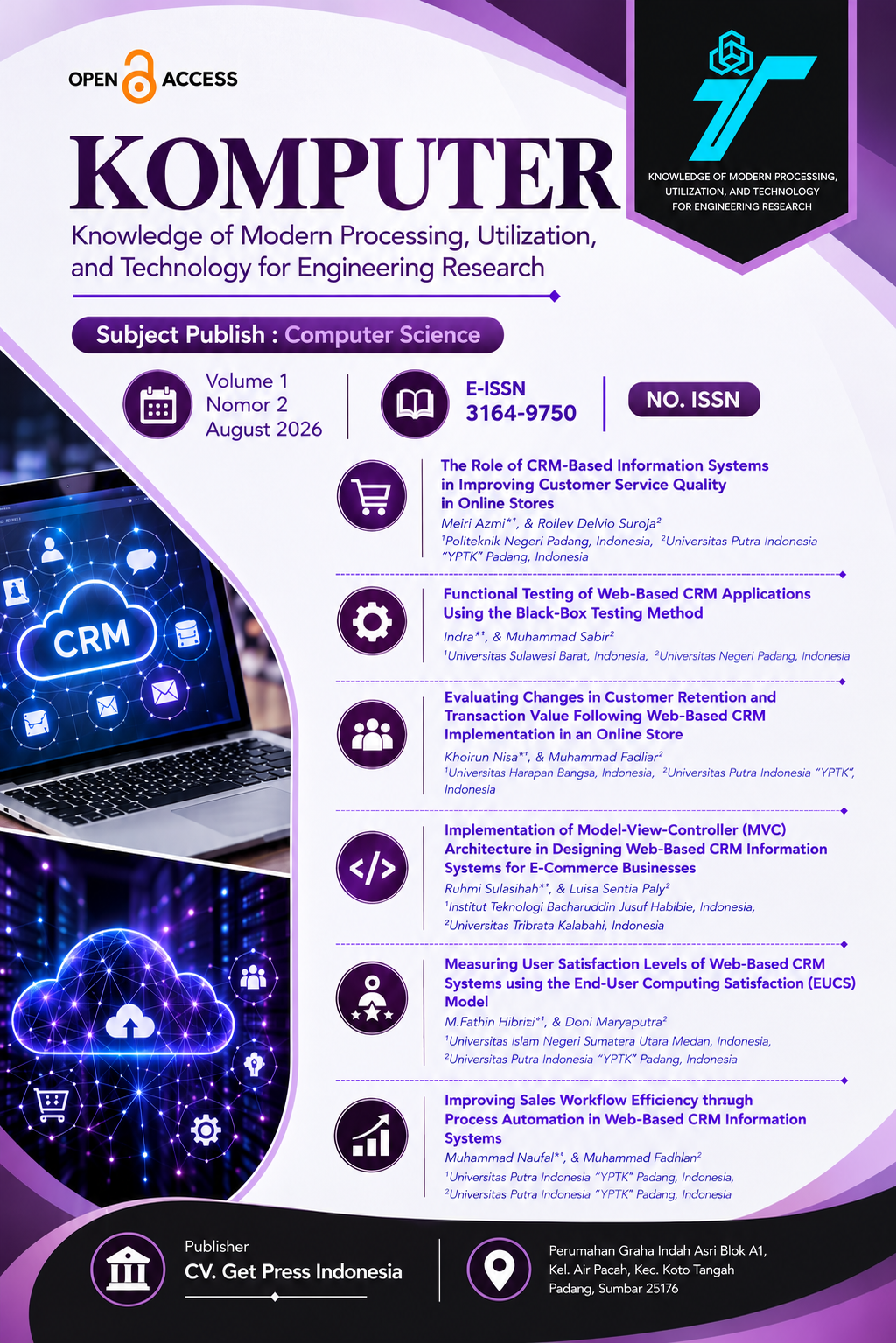
Measuring User Satisfaction Levels of Web-Based CRM Systems using the End-User Computing Satisfaction (EUCS) Model
DOI:
https://doi.org/10.69855/komputer.v1i2.862Keywords:
End-User Computing Satisfaction, CRM system, User satisfaction, PLS-SEM, Information systems evaluationAbstract
Web-based Customer Relationship Management (CRM) systems have become a core operational tool for sales and customer-service divisions, yet many organizations adopt such systems without systematically evaluating whether end users are actually satisfied with them. This study measures user satisfaction with a web-based CRM system using the End-User Computing Satisfaction (EUCS) model, which explains satisfaction through five dimensions: content, accuracy, format, ease of use, and timeliness. A quantitative survey was conducted among 110 sales, marketing, and customer-service staff who use the CRM system daily at a mid-sized distribution company in West Sumatra, Indonesia. Data were analyzed using Partial Least Squares Structural Equation Modeling (PLS-SEM) with SmartPLS. The measurement model showed adequate convergent and discriminant validity, and the structural model showed that content (β = 0.281, p < 0.01), accuracy (β = 0.314, p < 0.01), format (β = 0.146, p < 0.05), ease of use (β = 0.239, p < 0.01), and timeliness (β = 0.118, p < 0.05) each had a positive and significant effect on user satisfaction, jointly explaining 64.2 percent of its variance (R² = 0.642). Accuracy was the strongest predictor, followed by content and ease of use, while timeliness showed the weakest, though still significant, effect. Importance-Performance Analysis further identified ease of use as a high-importance, comparatively lower-performance dimension requiring priority improvement. These findings offer CRM administrators an evidence-based basis for prioritizing system-enhancement efforts and confirm the continued relevance of the EUCS model for evaluating web-based enterprise information systems.
References
Aini, F., Muttakin, F., Ahsyar, T. K., & Saputra, E. (2023). Analisis kepuasan pengguna aplikasi DANA menggunakan metode TAM dan EUCS. Jurnal Sistem Cerdas, 6(1), 65–76. https://doi.org/10.37396/jsc.v6i1.288
Akhiruddin, D. R., Negara, E. S., Sutabri, T., & Herdiansyah, M. I. (2023). Analisis kepuasan pengguna Sistem Informasi Pemerintah Daerah (SIPD) pada Badan Pengelola Keuangan dan Aset Daerah Kabupaten Ogan Komering Ilir dengan metode End-User Computing Satisfaction (EUCS). Jurnal Teknologi Informatika dan Komputer MH. Thamrin, 9(2), 834–849.
Al Fakhirah, A., & Sekarwati, K. A. (2022). Analisis tingkat kepuasan pengguna aplikasi WeTV menggunakan metode End User Computing Satisfaction (EUCS). Jurnal Ilmiah Komputasi, 21(4). https://doi.org/10.32409/jikstik.21.4.3217
Anahyu, Y. D., Zarnelly, Z., Rozanda, N. E., & Megawati, M. (2024). Analisis kepuasan pengguna akhir aplikasi MyTelkomsel menggunakan metode End User Computing Satisfaction (EUCS). Jurnal INOVTEK Polbeng, 9(1).
Ariska, A. S., & Sanjaya, M. R. (2024). Analisis tingkat kepuasan pengguna aplikasi Sistem Informasi Akademik (SIAKAD) berbasis website menggunakan metode End-User Computing Satisfaction (EUCS). Indonesian Journal of Computer Science, 12(6). https://doi.org/10.33022/ijcs.v12i6.3583
Baqi, M. H., Setyadi, R., & Purbaya, M. E. (2022). Analisis kepuasan Sistem Informasi Desa Sidomoro di Kabupaten Kebumen menggunakan metode End User Computing Satisfaction. JURIKOM (Jurnal Riset Komputer), 9(2), 211–217. https://doi.org/10.30865/jurikom.v9i2.3984
Chin, W. W. (1998). The partial least squares approach to structural equation modeling. In G. A. Marcoulides (Ed.), Modern methods for business research (pp. 295–336). Lawrence Erlbaum Associates.
Davis, F. D. (1989). Perceived usefulness, perceived ease of use, and user acceptance of information technology. MIS Quarterly, 13(3), 319–340. https://doi.org/10.2307/249008
DeLone, W. H., & McLean, E. R. (2003). The DeLone and McLean model of information systems success: A ten-year update. Journal of Management Information Systems, 19(4), 9–30. https://doi.org/10.1080/07421222.2003.11045748
Doll, W. J., & Torkzadeh, G. (1988). The measurement of end-user computing satisfaction. MIS Quarterly, 12(2), 259–274. https://doi.org/10.2307/248851
Fornell, C., & Larcker, D. F. (1981). Evaluating structural equation models with unobservable variables and measurement error. Journal of Marketing Research, 18(1), 39–50. https://doi.org/10.2307/3151312
Hair, J. F., Howard, M. C., & Nitzl, C. (2020). Assessing measurement model quality in PLS-SEM using confirmatory composite analysis. Journal of Business Research, 109, 101–110. https://doi.org/10.1016/j.jbusres.2019.11.069
Hair, J. F., Hult, G. T. M., Ringle, C. M., Sarstedt, M., Danks, N. P., & Ray, S. (2021). Partial least squares structural equation modeling (PLS-SEM) using R: A workbook. Springer International Publishing.
Hair, J. F., Risher, J. J., Sarstedt, M., & Ringle, C. M. (2019). When to use and how to report the results of PLS-SEM. European Business Review, 31(1), 2–24. https://doi.org/10.1108/EBR-11-2018-0203
Henseler, J., Ringle, C. M., & Sarstedt, M. (2015). A new criterion for assessing discriminant validity in variance-based structural equation modeling. Journal of the Academy of Marketing Science, 43(1), 115–135. https://doi.org/10.1007/s11747-014-0403-8
Ives, B., Olson, M. H., & Baroudi, J. J. (1983). The measurement of user information satisfaction. Communications of the ACM, 26(10), 785–793. https://doi.org/10.1145/358413.358430
Jamil, M., & Ahmad, N. (2022). The impact of CRM system on customer satisfaction and loyalty: A study of Indonesian banking sector. Journal of Asian Finance, Economics and Business, 9(3), 245–254.
Kumar, V., & Reinartz, W. (2018). Customer relationship management: Concept, strategy, and tools (3rd ed.). Springer.
Marolt, M., Zimmermann, H. D., Žnidaršič, A., & Pucihar, A. (2020). Exploring social customer relationship management adoption in micro, small and medium-sized enterprises. Journal of Theoretical and Applied Electronic Commerce Research, 15(3), 38–58.
Martilla, J. A., & James, J. C. (1977). Importance-performance analysis. Journal of Marketing, 41(1), 77–79. https://doi.org/10.2307/1250495
Nethanani, R., Matlombe, L., Vuko, S. N., & Thango, B. (2024). Customer relationship management (CRM) systems and their impact on SMEs performance: A systematic review. Preprints. https://doi.org/10.20944/preprints202410.1538.v1
Petter, S., DeLone, W., & McLean, E. (2008). Measuring information systems success: Models, dimensions, measures, and interrelationships. European Journal of Information Systems, 17(3), 236–263. https://doi.org/10.1057/ejis.2008.15
Rahmawati, D., & Suryana, T. (2023). Analisis kepuasan pengguna sistem CRM berbasis web menggunakan metode EUCS pada perusahaan distribusi. Jurnal Sistem Informasi dan Teknologi, 5(2), 112–123.
Seddon, P. B. (1997). A respecification and extension of the DeLone and McLean model of IS success. Information Systems Research, 8(3), 240–253. https://doi.org/10.1287/isre.8.3.240
Setiawan, H., & Novita, D. (2021). Analisis kepuasan pengguna aplikasi KAI Access sebagai media pemesanan tiket kereta api menggunakan metode EUCS. Jurnal Teknologi Sistem Informasi, 2(2), 162–175. https://doi.org/10.35957/jtsi.v2i2.1375
Sugiyono. (2019). Metode penelitian kuantitatif, kualitatif, dan R&D. Alfabeta.
Urbach, N., & Ahlemann, F. (2010). Structural equation modeling in information systems research using partial least squares. Journal of Information Technology Theory and Application, 11(2), 5–40.
Wibowo, A., & Kurniawan, D. (2021). Evaluasi kepuasan pengguna sistem informasi manajemen pelanggan dengan pendekatan End-User Computing Satisfaction. Jurnal Teknologi Informasi dan Pendidikan, 14(1), 45–56.
Yasiukovich, S., & Haddara, M. (2021). Social CRM in SMEs: A systematic literature review. Procedia Computer Science, 181, 535–544. https://doi.org/10.1016/j.procs.2021.01.200
Zviran, M., Pliskin, N., & Levin, R. (2005). Measuring user satisfaction and perceived usefulness in the ERP context. Journal of Computer Information Systems, 45(3), 43–52. https://doi.org/10.1080/08874417.2005.11645843
Downloads
Published
How to Cite
Issue
Section
License
Copyright (c) 2026 M.Fathin Hibrizi, Doni Maryaputra

This work is licensed under a Creative Commons Attribution 4.0 International License.