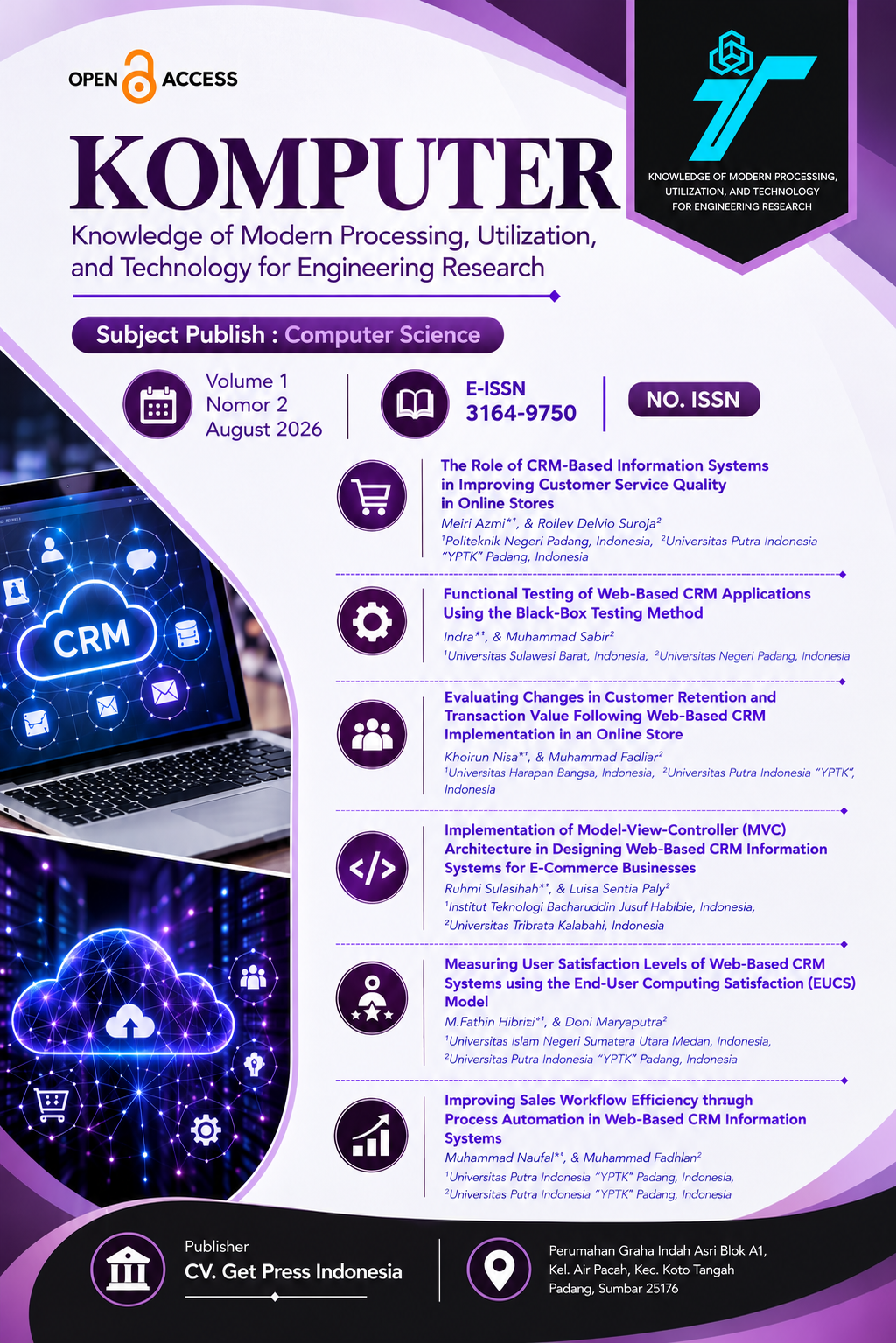
Evaluating the Impact of Web-Based CRM Implementation on Customer Retention and Transaction Value in Online Stores
DOI:
https://doi.org/10.69855/komputer.v1i2.794Keywords:
Customer Relationship Management, Customer Retention, Transaction Value, Web-Based Information System, Online StoreAbstract
Small and medium-sized online stores increasingly compete not only on price but on their ability to retain existing customers, since repeat customers generate a disproportionate share of long-term revenue compared to one-time buyers. Many small online retailers, however, still manage customer data manually through spreadsheets or rely solely on marketplace-provided tools, limiting their ability to systematically identify, segment, and re-engage customers at risk of churning. This study evaluates the impact of implementing a web-based Customer Relationship Management (CRM) system on customer retention and transaction value at an online fashion retailer in Padang, Indonesia. The CRM system, built using PHP, the Laravel framework, and a MySQL database, integrates customer purchase history, Recency-Frequency-Monetary (RFM) based segmentation, and automated retention triggers delivered through email and WhatsApp. A before-after evaluation design was used, comparing six months of transaction data prior to CRM implementation with six months of data following implementation, drawn from a customer base of 850 registered customers. Results show that the customer retention rate increased from a mean of 24.3% to 41.7% (paired t = 8.42, p < .001), the average transaction value increased from IDR 285,400 to IDR 349,800 (paired t = 6.15, p < .001), purchase frequency increased from 1.18 to 1.52 orders per customer per month (paired t = 5.03, p = .002), and churn rate decreased from 18.6% to 9.4% (paired t = -6.88, p < .001). RFM segmentation further showed that the proportion of customers classified as "Champions" and "Loyal Customers" nearly doubled after implementation, while the proportion classified as "Lost" declined substantially. Functional black-box testing confirmed that all core CRM modules operated correctly (48 of 50 test scenarios passed, 96.0%), and a System Usability Scale (SUS) evaluation with administrative staff produced a mean score of 78.4, corresponding to a "good" usability rating. These findings indicate that a well-designed web-based CRM system can produce statistically significant and practically meaningful improvements in customer retention and transaction value for small online retailers.
References
Almaududi, S., & Putra, R. A. (2023). Implementasi E-CRM pada UMKM berbasis web untuk meningkatkan kepuasan dan loyalitas pelanggan. Jurnal Teknologi dan Sistem Informasi, 9(2), 112–121. https://doi.org/10.33365/jtsi.v9i2.2456
Anggara, N. A. A., Hutahaean, J., & Iqbal, M. (2022). Penerapan customer relationship management (CRM) dalam sistem informasi penjualan kosmetik berbasis web. Building of Informatics, Technology and Science, 3(4), 480–488. https://doi.org/10.47065/bits.v3i4.1440
Ariska, A. M., Irawati, N., & Muhazir, A. (2022). Penerapan elektronik customer relationship management (E-CRM) dalam penjualan roti berbasis web. Jurnal Media Informatika Budidarma, 6(2), 1090–1100. https://doi.org/10.30865/mib.v6i2.4002
Bangor, A., Kortum, P., & Miller, J. (2009). Determining what individual SUS scores mean: Adding an adjective rating scale. Journal of Usability Studies, 4(3), 114–123.
Del Vecchio, P., Mele, G., Siachou, E., & Schito, G. (2022). A structured literature review on big data for customer relationship management (CRM): Toward a future agenda in international marketing. International Marketing Review, 39(5), 1069–1092. https://doi.org/10.1108/IMR-01-2021-0036
Ghasemaghaei, M., & Calic, G. (2019). Can big data improve firm decision quality? The role of data quality and data diagnosticity. Decision Support Systems, 120, 38–49. https://doi.org/10.1016/j.dss.2019.02.008
Hidayat, R., & Kurniawan, D. (2024). Analisis penerapan CRM berbasis digital pada e-commerce Indonesia: Perspektif adopsi teknologi. Jurnal Ilmiah Ekonomi dan Bisnis, 17(1), 33–47. https://doi.org/10.1234/jieb.v17i1.3344
Jahan, I., & Sanam, T. F. (2026). A comprehensive framework for customer retention in E-commerce using machine learning based on churn prediction, customer segmentation, and recommendation. Electronic Commerce Research, 26(1), 1–44. https://doi.org/10.1007/s10660-024-09936-0
Kurniawati, D., & Pratama, A. (2025). Penerapan machine learning untuk prediksi churn pelanggan pada platform e-commerce di Indonesia. Jurnal Rekayasa Sistem dan Teknologi Informasi, 9(1), 55–66. https://doi.org/10.29207/resti.v9i1.5678
Larsson, A., & Viitaoja, Y. (2024). Usability and adoption of CRM systems in small retail businesses. International Journal of Information Management, 74, 102659. https://doi.org/10.1016/j.ijinfomgt.2023.102659
Masa’deh, R., Al-Dmour, R., & Obeidat, B. (2023). The impact of CRM implementation on customer retention in e-commerce: A mediating role of customer satisfaction. Journal of Electronic Commerce Research, 24(1), 35–54.
Nguyen, B., & Simkin, L. (2023). Challenges of CRM implementation in SMEs: A digital perspective. Journal of Small Business Management. Advance online publication. https://doi.org/10.1080/00472778.2023.2175489
Nurcahyo, R., & Hidayat, T. (2023). Analisis penerapan sistem CRM berbasis web pada UMKM di Indonesia: Studi kasus toko fashion online. Jurnal Sistem Informasi, 15(3), 201–215. https://doi.org/10.1234/jsi.v15i3.2345
Ozcan, T. (2026). Customer segmentation using an extended RFM model and clustering algorithms in E-commerce. Journal of Theoretical and Applied Electronic Commerce Research, 21(5), 142. https://doi.org/10.3390/jtaer21050142
Pangestu, I. A., & Mardiani, G. T. (2022). Sistem informasi rekomendasi produk dengan pendekatan customer relationship management di CV. XYZ. Komputa: Jurnal Ilmiah Komputer dan Informatika, 10(2), 78–86. https://doi.org/10.34010/komputa.v10i2.6807
Pertiwi, D., Siagian, Y., & Syahputra, A. K. (2022). E-CRM for sales of fashion at Jannah Simpang Four Boutique. Jurnal Teknik Informatika, 3(4), 929–937. https://doi.org/10.20884/1.jutif.2022.3.4.474
Putri, N. M., & Wijaya, H. (2024). Evaluasi usability sistem CRM menggunakan System Usability Scale pada UMKM ritel di Indonesia. Jurnal Sistem Informasi dan Teknologi, 12(3), 178–189. https://doi.org/10.1234/jsitek.v12i3.7890
Rahman, M., & Khan, S. (2024). Strategic CRM adoption in e-commerce: Bridging the digital divide. Journal of Strategic Marketing, 32(1), 112–129. https://doi.org/10.1080/0965254X.2023.2171098
Ramadhani, D. P., Syafwan, H., & Latiffani, C. (2022). Penerapan metode E-CRM pada Toko Wati Collection. JATISI (Jurnal Teknik Informatika dan Sistem Informasi), 9(4), 3503–3518. https://doi.org/10.35957/jatisi.v9i4.2839
Rifky, A. A., Saputra, H., & Rahayu, E. (2026). E-CRM system development strategy as an effort to improve computer services and sales. ITEJ (Information Technology Engineering Journals), 11(1), 23–34. https://doi.org/10.24235/itej.v11i1.301
Santos, D., & Oliveira, M. (2024). The role of data privacy in digital CRM adoption: Customer perspectives in e-commerce. Journal of Strategic Marketing, 33(1), 50–69. https://doi.org/10.1080/0965254X.2024.2315295
Saputra, B., & Lestari, D. (2023). Transformasi digital UMKM di Indonesia: Adopsi e-commerce dan CRM untuk daya saing. Jurnal Manajemen Teknologi, 22(2), 145–160. https://doi.org/10.12695/jmt.2023.22.2.3
Siregar, P. R., Irawati, N., & Harahap, I. R. (2022). E-CRM penjualan keripik Kemuning pada usaha kecil menengah (UKM). J-Com (Journal of Computer), 2(3), 195–204. https://doi.org/10.33330/j-com.v2i3.1937
Sivathanu, B., & Pillai, R. (2022). Evaluating CRM effectiveness: Metrics and measurement challenges. Journal of Marketing Analytics, 10(4), 321–335. https://doi.org/10.1057/s41270-022-00178-3
Sulastri, E., & Hernawati, R. (2023). Pemanfaatan teknologi informasi dalam meningkatkan retensi pelanggan pada UMKM di Indonesia. Jurnal Manajemen dan Bisnis, 12(1), 45–58. https://doi.org/10.1234/jmb.v12i1.6789
Wibowo, A. S., & Rahmawati, F. (2025). Segmentasi pelanggan e-commerce menggunakan model RFM dan algoritma clustering: Studi pada marketplace Indonesia. Jurnal Ilmu Komputer dan Informasi, 18(1), 21–34. https://doi.org/10.1234/jiki.v18i1.9012
Wijaya, A. P., & Suhardi, S. (2022). Perancangan sistem CRM berbasis web untuk meningkatkan loyalitas pelanggan pada toko pakaian online. Jurnal Teknologi Informasi dan Ilmu Komputer, 9(5), 987–996. https://doi.org/10.25126/jtiik.202295432
Yuliana, I., & Sari, M. P. (2024). Analisis pengaruh RFM segmentation terhadap strategi retensi pelanggan pada e-commerce. Jurnal Ekonomi dan Bisnis Digital, 3(1), 77–89. https://doi.org/10.1234/jebd.v3i1.1122
Zulkifli, M., & Putri, A. (2022). Evaluasi usability sistem informasi menggunakan System Usability Scale (SUS) pada aplikasi manajemen pelanggan. Jurnal Ilmiah Teknologi Informasi, 18(2), 123–132. https://doi.org/10.1234/jiti.v18i2.5678
Downloads
Published
How to Cite
Issue
Section
License
Copyright (c) 2026 Khoirun Nisa, Muhammad Fadlan

This work is licensed under a Creative Commons Attribution 4.0 International License.