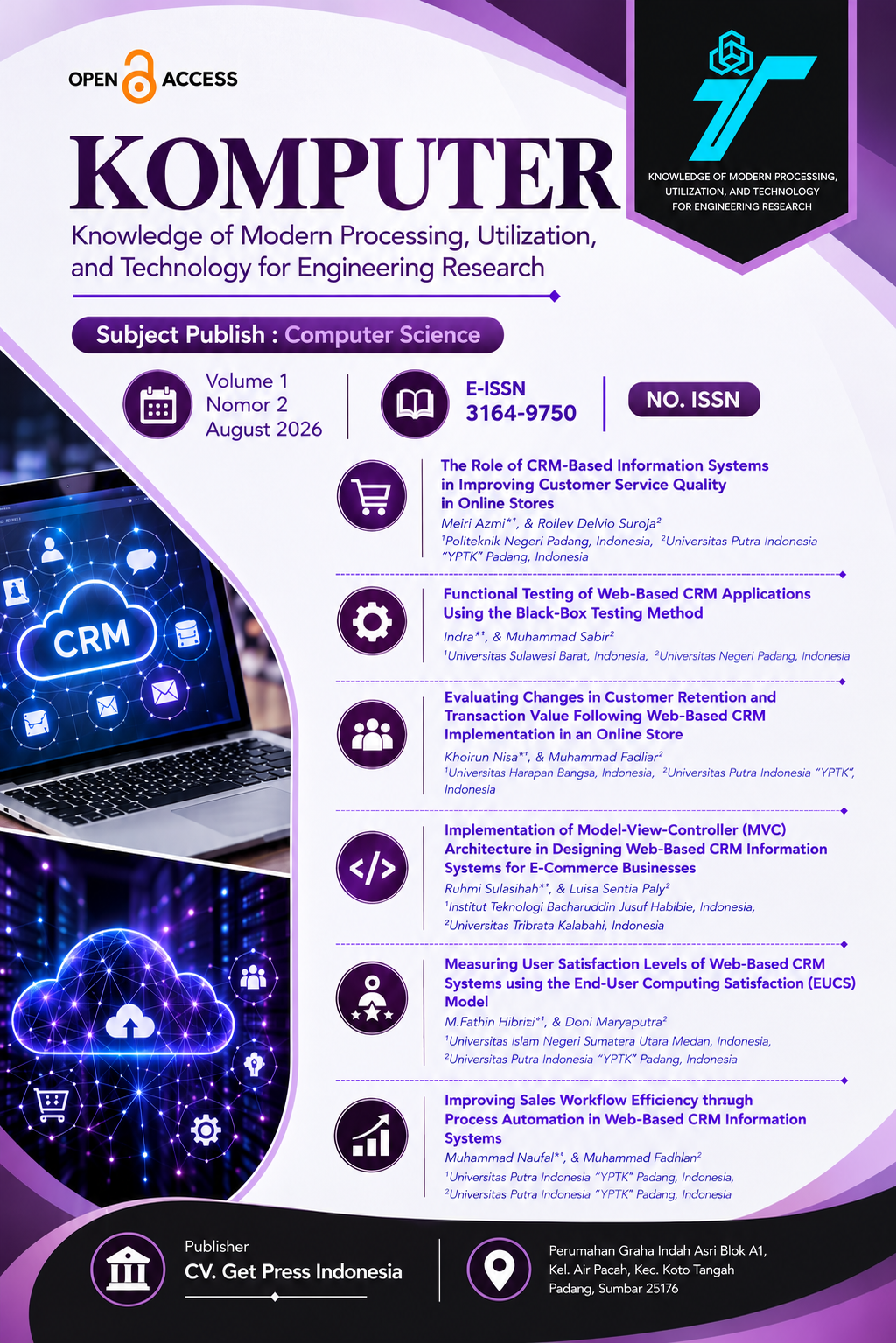
Implementation of Model-View-Controller (MVC) Architecture in Designing Web-Based CRM Information Systems for E-Commerce Businesses
DOI:
https://doi.org/10.69855/komputer.v1i2.742Keywords:
Customer Relationship Management (CRM), Model-View-Controller (MVC), E-CommerceAbstract
Small and medium-sized e-commerce businesses increasingly rely on Customer Relationship Management (CRM) systems to manage customer data, sales leads, transactions, and interactions. However, many web-based CRM applications still use procedural and tightly coupled code, making them difficult to maintain and extend. This study designs and implements a web-based CRM information system using the Model-View-Controller (MVC) architectural pattern to improve maintainability and performance. The system was developed using the Waterfall System Development Life Cycle (SDLC), with requirements gathered through purposive-sampling interviews with two SME e-commerce operators. The prototype was implemented using the Laravel framework, MySQL database, and Eloquent Object-Relational Mapping (ORM), supporting customer management, lead tracking, order and product management, and interaction logging. Evaluation employed black-box testing with equivalence partitioning across seven functional modules, ISO/IEC 25010:2023 quality testing, and load testing against a non-MVC monolithic baseline. Black-box testing achieved a 98.0% success rate across 100 test scenarios, while ISO/IEC 25010 evaluation produced an average quality score of 91.3%, with all eight characteristics exceeding the 80% acceptance threshold. Load testing showed that the MVC-based prototype maintained substantially lower average response times than the monolithic baseline as concurrent users increased from 10 to 100. These findings demonstrate that MVC architecture can improve functional reliability, maintainability, and performance stability in e-commerce CRM systems.
References
Al Farisi, M. F., & Purwanto, A. (2022). Penerapan metode CRM pada perancangan sistem informasi penjualan pakaian dan aksesoris. JURIKOM (Jurnal Riset Komputer), 9(4), 902–908. https://doi.org/10.30865/jurikom.v9i4.4647
Al Mudzakir, T., & Bakar, A. (2020). Desain dan implementasi customer relationship management berbasis web (studi kasus: Toko Baju Ladya). Systematics, 2(1), 1–8. https://doi.org/10.35706/sys.v2i1.3444
Alshurideh, M. (2023). Does social customer relationship management (SCRM) affect customers' happiness and retention? A service perspective. Uncertain Supply Chain Management, 11(2), 581–588. https://doi.org/10.5267/j.uscm.2022.9.015
Anggraeni, L. A. (2024). Tantangan kompetisi dan risiko monopoli dalam transformasi digital e-commerce dengan studi kasus aplikasi TikTok di Indonesia. Sains: Jurnal Manajemen dan Bisnis, 16(1), 87–98. https://doi.org/10.35448/jmb.v16i1.23398
Asrul, A., Mashud, M., Qadri, M., Tamrin, F., & Ilham, A. S. (2023). Perancangan sistem e-commerce menggunakan metode customer relationship management. Jurnal Minfo Polgan, 12(1), 192–199. https://doi.org/10.33395/jmp.v12i1.12343
Avisya, L. (2023). Rancang bangun e-commerce penjualan buah menggunakan metode customer relationship management (CRM). ELTI: Jurnal Elektronika, Listrik dan Teknologi Informasi Terapan, 5(2), 68–73.
Ayunnggati, T., Lutfiani, N., & Millah, S. (2021). CRM-based e-business design (customer relationship management) case study: Shoe washing service company S-Neat-Kers. International Journal of Cyber and IT Service Management, 1(2), 216–225. https://doi.org/10.34306/ijcitsm.v1i2.58
Basir, F. M., Guna, S. L. G., & Sitorus, S. H. S. (2023). Pengembangan website penjualan W'D Cakes & Cookies dengan integrasi CRM dalam meningkatkan loyalitas pelanggan. Jurnal Ilmiah Sistem Informasi (JISI), 10(1), 44–53. https://doi.org/10.33510/jisi.v10i1.189
Br Purba, Y. D., & Harahap, A. M. (2024). Customer relationship management strategy in mobile-based e-commerce platform development to increase purchase interest. Journal of Computer Networks, Architecture and High Performance Computing, 6(3), 1356–1367. https://doi.org/10.47709/cnahpc.v6i3.4365
Del Vecchio, P., Mele, G., Siachou, E., & Schito, G. (2022). A structured literature review on big data for customer relationship management (CRM): Toward a future agenda in international marketing. International Marketing Review, 39(5), 1069–1092. https://doi.org/10.1108/IMR-01-2021-0036
Golian, N. V., Golian, V. V., & Afanasieva, I. V. (2022). Black and white-box unit testing for web applications. Bulletin of Kharkiv National Automobile and Highway University.
Gustinov, M. D., Azani, N. W., Al Ghani, R., Auliani, S. N., Maharani, S., Hamzah, M. L., & Rizki, M. (2023). Analysis of web-based e-commerce testing using black box and white box methods. International Journal of Information System and Innovation Management (IJISIM), 1(1), 20–31.
International Organization for Standardization. (2023). ISO/IEC 25010:2023 Systems and software engineering Systems and software quality requirements and evaluation (SQuaRE) Product quality model. ISO.
Muhram, A. R., & Mustikasari, M. (2022). Analysis of the quality of web-based online exams in the education and training agency of the Indonesian attorney general's office using ISO 25010 standards. Indonesian Journal of Multidisciplinary Science, 1(12), 1541–1556. https://doi.org/10.55324/ijoms.v1i12.228
Pulungan, R. A. S., & Hidayanto, A. N. (2023). Evaluating e-commerce system acceptance using UAT and Likert scale analysis for sustainable business. Journal of Theoretical and Applied Information Technology, 101(12), 4810–4822.
Ramadhani, D. P., Syafwan, H., & Latiffani, C. (2022). Penerapan metode E-CRM pada Toko Wati Collection. JATISI (Jurnal Teknik Informatika dan Sistem Informasi), 9(4), 3503–3518. https://doi.org/10.35957/jatisi.v9i4.2839
Subari, A., Wardhana, R. W., Yulanda, F., & Rahman, R. (2021). Implementation of MVC (Model-View-Controller) architecture in online submission and reporting process at official travel warrant information system based on web application. Journal of Physics: Conference Series.
Wattiheluw, F. H., Rochimah, S., Fatichah, C., & Abidin, K. Z. (2020). Development of a quality model based on ISO 25010 using fuzzy and PSO for e-commerce websites. In 2020 17th International Conference on Electrical Engineering/Electronics, Computer, Telecommunications and Information Technology (ECTI-CON) (pp. 1–4). IEEE.
Wijaya, A. F., & Wardijono, B. A. (2023). Pengukuran kualitas aplikasi Custody berdasarkan ISO 25010 menggunakan otomatisasi pengujian blackbox. KLIK: Kajian Ilmiah Informatika dan Komputer, 4(2), 937–946. https://doi.org/10.30865/klik.v4i2.1215
Wulandari, A. S., Saepudin, A., Kinanti, M. P., Sudesi, Z., Saifudin, A., & Yulianti, Y. (2022). Pengujian aplikasi sistem informasi akademik berbasis web menggunakan metode black box testing equivalence partitioning. Jurnal Teknologi Sistem Informasi dan Aplikasi, 5(2), 102–107. https://doi.org/10.32493/jtsi.v5i2.17561
Downloads
Published
How to Cite
Issue
Section
License
Copyright (c) 2026 Ruhmi Sulaehani, Luisa Sentia Paly

This work is licensed under a Creative Commons Attribution 4.0 International License.