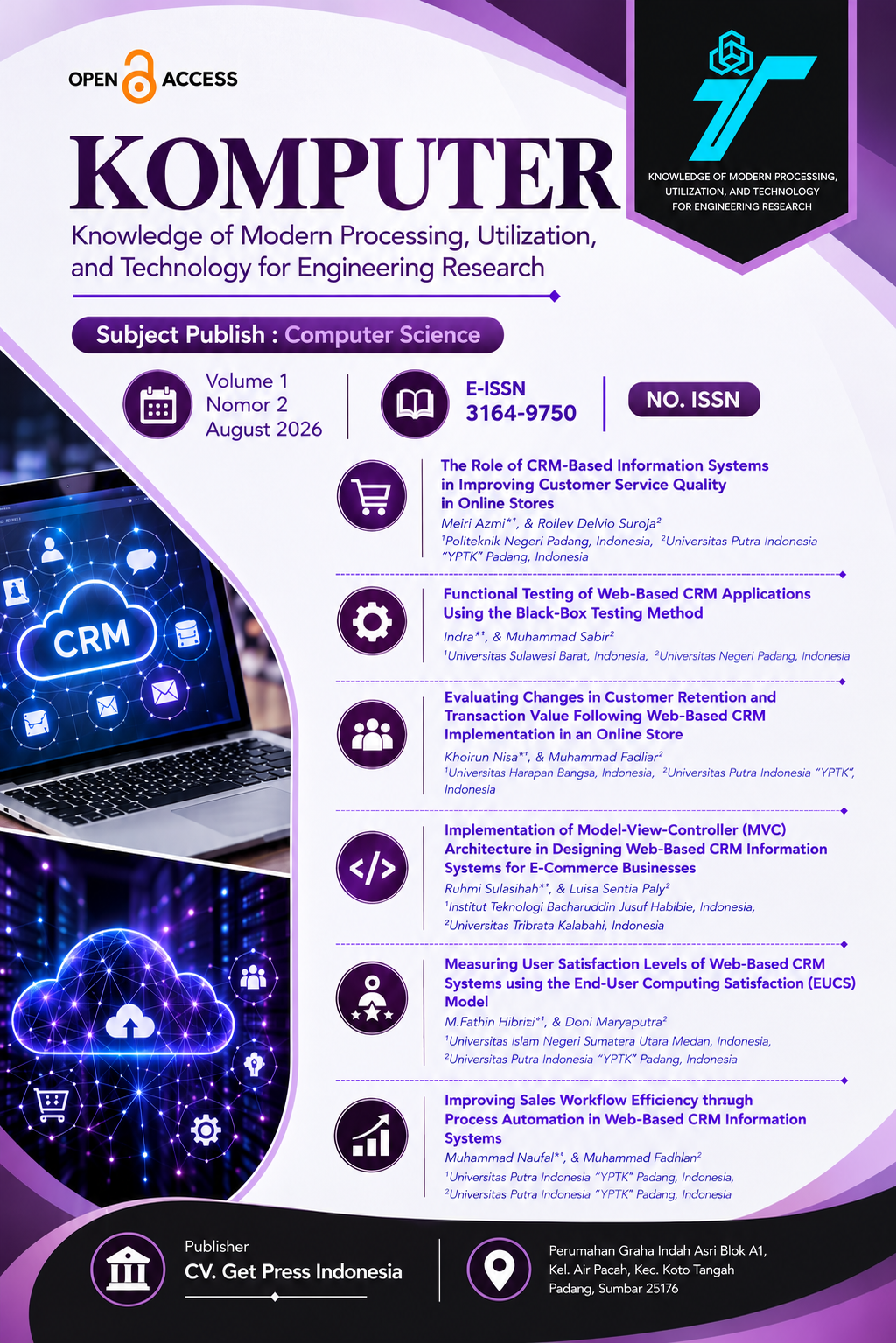
Functional Testing of Web-Based CRM Applications Using the Black-Box Testing Method
DOI:
https://doi.org/10.69855/komputer.v1i2.741Keywords:
Black-box testing, CRM application, Equivalence partitioning, Boundary value analysis, ISO/IEC 25010Abstract
Customer Relationship Management (CRM) applications play a central role in supporting sales, lead, and customer-service processes for modern organizations, making the functional reliability of such systems critical to business operations. This study evaluates the functional quality of a web-based CRM application using the black-box testing method, combining Equivalence Partitioning (EP), Boundary Value Analysis (BVA), and Decision Table Testing (DTM) techniques across seven core functional modules: user authentication, lead management, contact management, sales pipeline, task and activity management, reporting and dashboard, and email integration. A total of 174 test cases were designed based on functional requirement specifications and executed manually over three testing cycles. In the first testing cycle, 126 of 174 test cases passed, yielding an overall pass rate of 72.2% and revealing 48 defects, including 6 critical, 14 major, 19 minor, and 9 cosmetic issues, predominantly related to input validation, session handling, and duplicate-lead detection. After defect remediation, a second cycle raised the pass rate to 90.9%, and a third verification cycle achieved a final pass rate of 98.2%, exceeding the project's 95% acceptance threshold. Functional suitability was further assessed against the ISO/IEC 25010 quality model, showing marked improvement in functional correctness and completeness across cycles. These results demonstrate that a structured black-box testing strategy combining EP, BVA, and DTM is effective in systematically uncovering functional defects in web-based CRM systems and in providing measurable evidence of software quality improvement prior to production release.
References
Alshamaa, Z. M., & Saleem, N. N. (2025). Black box software testing techniques: A literature review. Passer Journal of Basic and Applied Sciences, 7(2), 1001–1011.
Amalia, A., Hamidah, S. W. P., & Kristanto, T. (2021). Pengujian black box menggunakan teknik equivalence partitions pada aplikasi e-learning berbasis web. Building of Informatics, Technology and Science (BITS), 3(3), 269–274. https://doi.org/10.47065/bits.v3i3.1062
Ammann, P., & Offutt, J. (2017). Introduction to software testing (2nd ed.). Cambridge University Press.
Aryandana, I. G. S., Permanasari, A. E., & Adji, T. B. (2020). Comparing method equivalence class partitioning and boundary value analysis with study case add medicine module. IOP Conference Series: Materials Science and Engineering, 732(1), 012072. https://doi.org/10.1088/1757-899X/732/1/012072
Bajjouk, M., Rana, M. E., Ramachandiran, C. R., & Chelliah, S. (2021). Software testing for reliability and quality improvement. Journal of Applied Technology and Innovation, 5(2), 1–8.
Beizer, B. (1995). Black-box testing: Techniques for functional testing of software and systems. John Wiley & Sons.
Bhat, A., & Quadri, S. M. K. (2015). Equivalence class partitioning and boundary value analysis: A review. In 2015 2nd International Conference on Computing for Sustainable Global Development (INDIACom) (pp. 1557–1562). IEEE.
Burnstein, I. (2003). Practical software testing: A process-oriented approach. Springer.
Copeland, L. (2004). A practitioner's guide to software test design. Artech House.
Graham, D., & Fewster, M. (2012). Experiences of test automation: Case studies of software test automation. Addison-Wesley.
International Organization for Standardization. (2023). ISO/IEC 25010:2023—Systems and software quality requirements and evaluation (SQuaRE)—Product quality model.
Kaner, C., Falk, J., & Nguyen, H. Q. (1999). Testing computer software (2nd ed.). Wiley.
Khan, M. E., & Khan, F. (2012). A comparative study of white box, black box and grey box testing techniques. International Journal of Advanced Computer Science and Applications, 3(6), 12–15. https://doi.org/10.14569/IJACSA.2012.030603
Kitchenham, B., & Charters, S. (2007). Guidelines for performing systematic literature reviews in software engineering (Technical Report EBSE-2007-01). Keele University & University of Durham.
Latiu, G. I., Cret, O. A., & Vacariu, L. (2012). Automatic test data generation for software path testing using evolutionary algorithms. In 2012 Third International Conference on Emerging Intelligent Data and Web Technologies (pp. 1–8). IEEE. https://doi.org/10.1109/EIDWT.2012.28
Martin-Lopez, A., Segura, S., & Ruiz-Cortés, A. (2021). RESTest: Automated black-box testing of RESTful web APIs. In Proceedings of the 30th ACM SIGSOFT International Symposium on Software Testing and Analysis (ISSTA 2021) (pp. 682–685). ACM. https://doi.org/10.1145/3460319.3469082
Myers, G. J., Sandler, C., & Badgett, T. (2011). The art of software testing (3rd ed.). John Wiley & Sons.
Nidhra, S., & Dondeti, J. (2012). Black box and white box testing techniques: A literature review. International Journal of Embedded Systems and Applications, 2(2), 29–50.
Patton, R. (2005). Software testing (2nd ed.). Sams Publishing.
Putri, A. T., Husnaya, A. A., Hadafi, M. D. F., Abdulmalik, H. I., Nasir, M., & Indriasari, S. (2025). Implementation of equivalence partitioning and boundary value analysis in black box testing: A case study on the admin website of PAUD KB Al Husna. Jurnal Teknologi dan Open Source, 8(2), 776–787. https://doi.org/10.36378/jtos.v8i2.5028
Putri, D. I. (2022). Teknik equivalence partitions untuk pengujian aplikasi manajemen kas dan inventaris berbasis web. Information Management and Business Review / Journal of Information Management, 6(2), 193. https://doi.org/10.51211/imbi.v6i2.1922
Santi, P. A. D. A., Afwani, R., Albar, M. A., Anjarwani, S. E., & Mardiansyah, A. Z. (2022). Black box testing with equivalence partitioning and boundary value analysis methods (Study case: Academic information system of Mataram University). In Proceedings of the First Mandalika International Multi-Conference on Science and Engineering 2022 (MIMSE 2022) (pp. 207–219). Atlantis Press. https://doi.org/10.2991/978-94-6463-084-8_19
Sarwosri, S., Rochimah, S., Laili Yuhana, U., & Balqis Hidayat, S. (2023). Software quality measurement for functional suitability, performance efficiency, and reliability characteristics using Analytical Hierarchy Process. JOIV: International Journal on Informatics Visualization, 7(4), 2421–2426. https://doi.org/10.62527/joiv.7.4.2441
Selviana, E. Z., Wahanani, H. E., & Aditiawan, F. P. (2023). Black box testing in community service systems using boundary value analysis and cause effect graph methods (Case study of Jombang District Community and Village Empowerment Service). East Asian Journal of Multidisciplinary Research, 2(10), 4161–4184. https://doi.org/10.55927/eajmr.v2i10.6435
Singh, S., & Kumar, R. (2018). A review on software testing techniques and tools. International Journal of Computer Sciences and Engineering, 6(4), 1–6.
Tsalatsah, I. E., Pratama, D., Hakim, A. R., Budiman, L. A., & Riyanto, J. (2022). Penggunaan teknik boundary value analysis untuk pengujian aplikasi stok barang. Jurnal Teknologi Sistem Informasi dan Aplikasi, 5(1), 14. https://doi.org/10.32493/jtsi.v5i1.14987
Utting, M., & Legeard, B. (2007). Practical model-based testing: A tools approach. Morgan Kaufmann.
Verma, R., & Beg, M. R. (2014). Generation of test cases using genetic algorithm and fuzzy logic. International Journal of Computer Applications, 97(21), 1–5.
Zen, M., Irwan, Hafni, & Ananda, M. D. P. (2024). Implementasi dan pengujian menggunakan metode black-box testing pada sistem informasi tracer study. Bulletin of Computer Science and Research, 4(4), 327–340. https://doi.org/10.47065/bulletincsr.v4i4.359
Zhang, C., & Xu, Y. (2020). A survey of software testing techniques. Journal of Physics: Conference Series, 1601(4), 042017. https://doi.org/10.1088/1742-6596/1601/4/042017
Downloads
Published
How to Cite
Issue
Section
License
Copyright (c) 2026 Indra, Muhammad Sabil

This work is licensed under a Creative Commons Attribution 4.0 International License.