
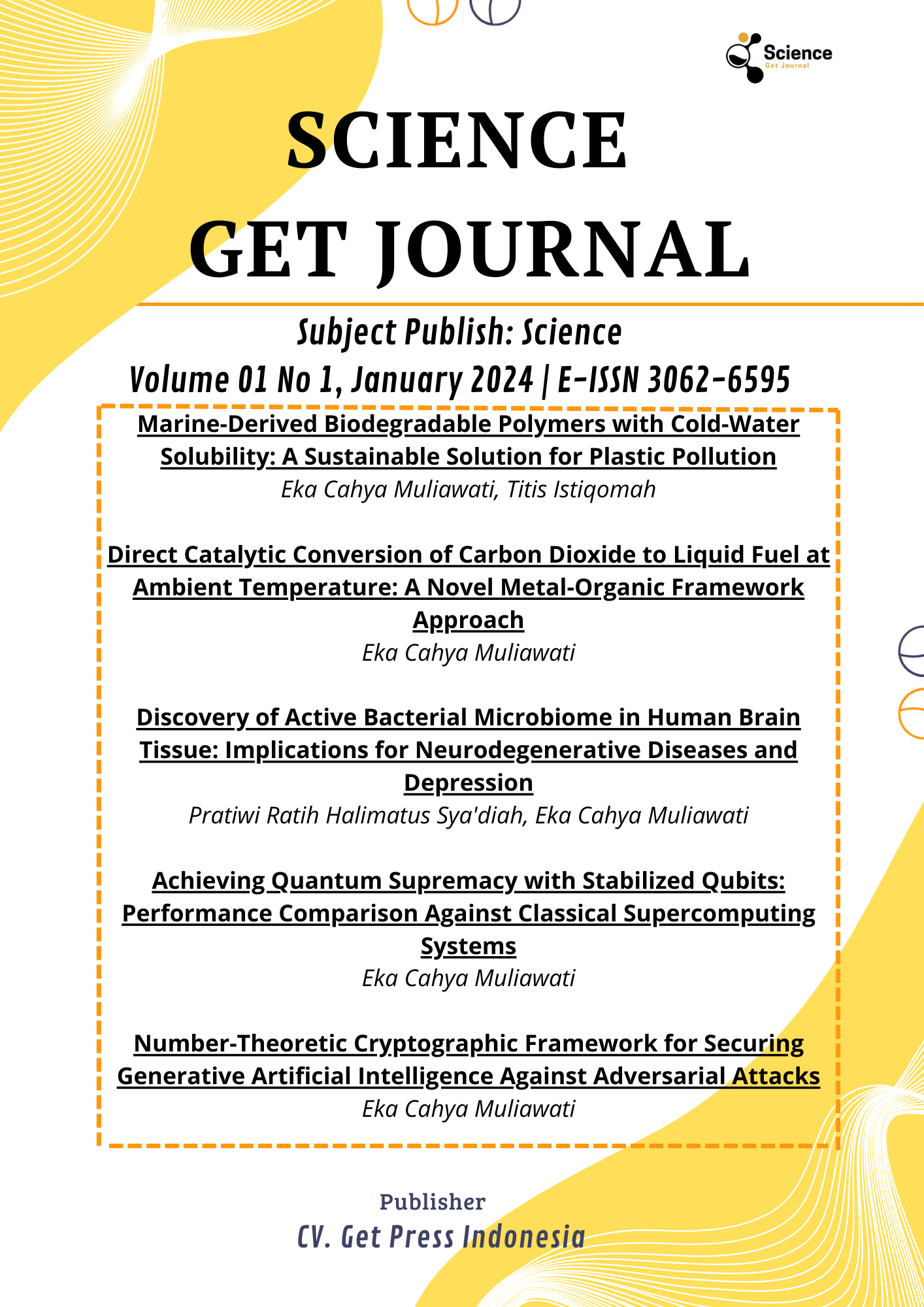
Marine-Derived Biodegradable Polymers for Cold-Water Marine Pollution
DOI:
https://doi.org/10.69855/science.v1i1.448Keywords:
Marine biodegradable polymers, Cold seawater, biodegradation, Marine derived biopolymers, Plastic pollutionAbstract
Marine plastic pollution persists as a global environmental crisis, particularly in cold-water marine environments where low temperatures significantly inhibit the degradation of most commercial biodegradable plastics. Conventional polymers such as polyethylene (PE) and polypropylene (PP) accumulate for decades, fragmenting into microplastics that permeate marine ecosystems from coastal zones to polar and deep-sea regions. Although biodegradable polymers have been proposed as an alternative, many widely used materials, including polylactic acid (PLA), exhibit negligible degradation in cold seawater. This study experimentally evaluates the degradation and solubility behavior of selected marine-derived biodegradable polymers under cold-water marine conditions, with a specific focus on temperature-dependent mechanisms. Emphasis is placed on comparative performance among candidate polymers, including marine-derived polysaccharides and microbially produced polyhydroxyalkanoates, as well as emerging supramolecular systems designed for rapid dissolution in seawater. By integrating experimental observations with insights from marine microbiology, polymer chemistry, and material design, this study identifies key pathways and design principles for developing polymers that remain effective in cold marine environments, contributing to the development of environmentally benign plastic alternatives
References
Barron, A., & Sparks, T. D. (2020). Commercial marine-degradable polymers for flexible packaging. iScience, 23(9), 101353. https://doi.org/10.1016/j.isci.2020.101353
Chia, W. Y., Tang, D. Y. Y., Khoo, K. S., Lup, A. N. K., & Chew, K. W. (2020). Nature’s fight against plastic pollution: Algae for plastic biodegradation and bioplastics production. Environmental Science and Ecotechnology, 4, 100065. https://doi.org/10.1016/j.ese.2020.100065
Feijoo, P., Marín, A., Sánchez-Safont, E., Tena-Medialdea, J., García-March, J. R., Gámez-Pérez, J., & Cabedo, L. (2025). Marine degradation of plastics in the western Mediterranean Sea: Comparison between biodegradable and conventional polymers. Polymer Degradation and Stability, 111222. https://doi.org/10.1016/j.polymdegradstab.2025.111222
Ghobish, S. A., Motti, C., Bissember, A. C., & Vamvounis, G. (2025). Microplastics in the marine environment: Challenges and the shift towards sustainable plastics and plasticizers. Journal of Hazardous Materials, 491, 137945. https://doi.org/10.1016/j.jhazmat.2025.137945
He, M., Hsu, Y., & Uyama, H. (2024). Superior sequence-controlled poly(L-lactide)-based bioplastic with tunable seawater biodegradation. Journal of Hazardous Materials, 474, 134819. https://doi.org/10.1016/j.jhazmat.2024.134819
Isobe, N., Ishii, S., & Nomaki, H. (2025). Progress and prospects in polymer science addressing plastic pollution in marine environments, including the deep-sea floor. Current Opinion in Chemical Engineering. https://doi.org/10.1016/j.coche.2024.101089
Khan, N., Sudhakar, K., & Mamat, R. (2024). Biodegradable plastics from marine biomass: A solution to marine plastic pollution. Journal of Hazardous Materials Advances, 100559. https://doi.org/10.1016/j.hazadv.2024.100559
Law, K. L., & Narayan, R. (2021). Reducing environmental plastic pollution by designing polymer materials for managed end-of-life. Nature Reviews Materials, 7, 104–116. https://doi.org/10.1038/s41578-021-00382-0
López-Ibáñez, S., & Beiras, R. (2022). Is a compostable plastic biodegradable in the sea? A rapid standard protocol to test mineralization in marine conditions. Science of the Total Environment, 154860. https://doi.org/10.1016/j.scitotenv.2022.154860
Lv, S., Li, Y., Zhao, S., & Shao, Z. (2024). Biodegradation of typical plastics: From microbial diversity to metabolic mechanisms. International Journal of Molecular Sciences, 25(1), 593. https://doi.org/10.3390/ijms25010593
Manfra, L., Marengo, V., Libralato, G., Costantini, M., De Falco, F., & Cocca, M. (2021). Biodegradable polymers: A real opportunity to solve marine plastic pollution? Journal of Hazardous Materials, 416, 125763. https://doi.org/10.1016/j.jhazmat.2021.125763
Olalla, A., Sara, L., & Beiras, R. (2021). Assessment of toxicity and biodegradability of poly(vinyl alcohol)-based materials in marine water. Polymers, 13(21), 3742. https://doi.org/10.3390/polym13213742
Oliveira, J., Almeida, P., Sobral, R., Lourenço, N., & Gaudêncio, S. (2022). Marine-derived actinomycetes: Biodegradation of plastics and formation of PHA bioplastics—A circular bioeconomy approach. Marine Drugs, 20(12), 760. https://doi.org/10.3390/md20120760
Suzuki, M., Ishii, S., Ohta, M., Gonda, K., Kashima, H., Arai, T., Tachibana, Y., Takeno, H., & Kasuya, K. (2024). Enhancing marine biodegradability of poly(butylene succinate) by blending with 16-hydroxyhexadecanoic acid and poly(ε-caprolactone). Polymer Degradation and Stability, 110912. https://doi.org/10.1016/j.polymdegradstab.2024.110912
Tennakoon, P., Chandika, P., Yi, M., & Jung, W. K. (2023). Marine-derived biopolymers as potential bioplastics, an eco-friendly alternative. iScience, 26(4), 106404. https://doi.org/10.1016/j.isci.2023.106404
Wang, G., Huang, D., Ji, J., Völker, C., & Wurm, F. R. (2020). Seawater-degradable polymers—Fighting the marine plastic pollution. Advanced Science, 8, 2001121. https://doi.org/10.1002/advs.202001121
Zhang, Y., Cao, Y., Chen, B., Dong, G., Zhao, Y., & Zhang, B. (2024). Marine biodegradation of plastic films by Alcanivorax under various ambient temperatures: Bacterial enrichment, morphology alteration, and release of degradation products. Science of the Total Environment, 170527. https://doi.org/10.1016/j.scitotenv.2024.170527
Zhao, S., Liu, L., Li, C., Zheng, H., Luo, Y., Pang, L., Lin, Q., Zhang, H., Sun, C., Chen, L., & Li, F. (2022). Photodegradation of biobased polymer blends in seawater: A major source of microplastics in the marine environment. Frontiers in Marine Science, 9, 1046179. https://doi.org/10.3389/fmars.2022.1046179
Downloads
Published
How to Cite
Issue
Section
License
Copyright (c) 2026 Eka Cahya Muliawati, Titis Istiqomah

This work is licensed under a Creative Commons Attribution 4.0 International License.