
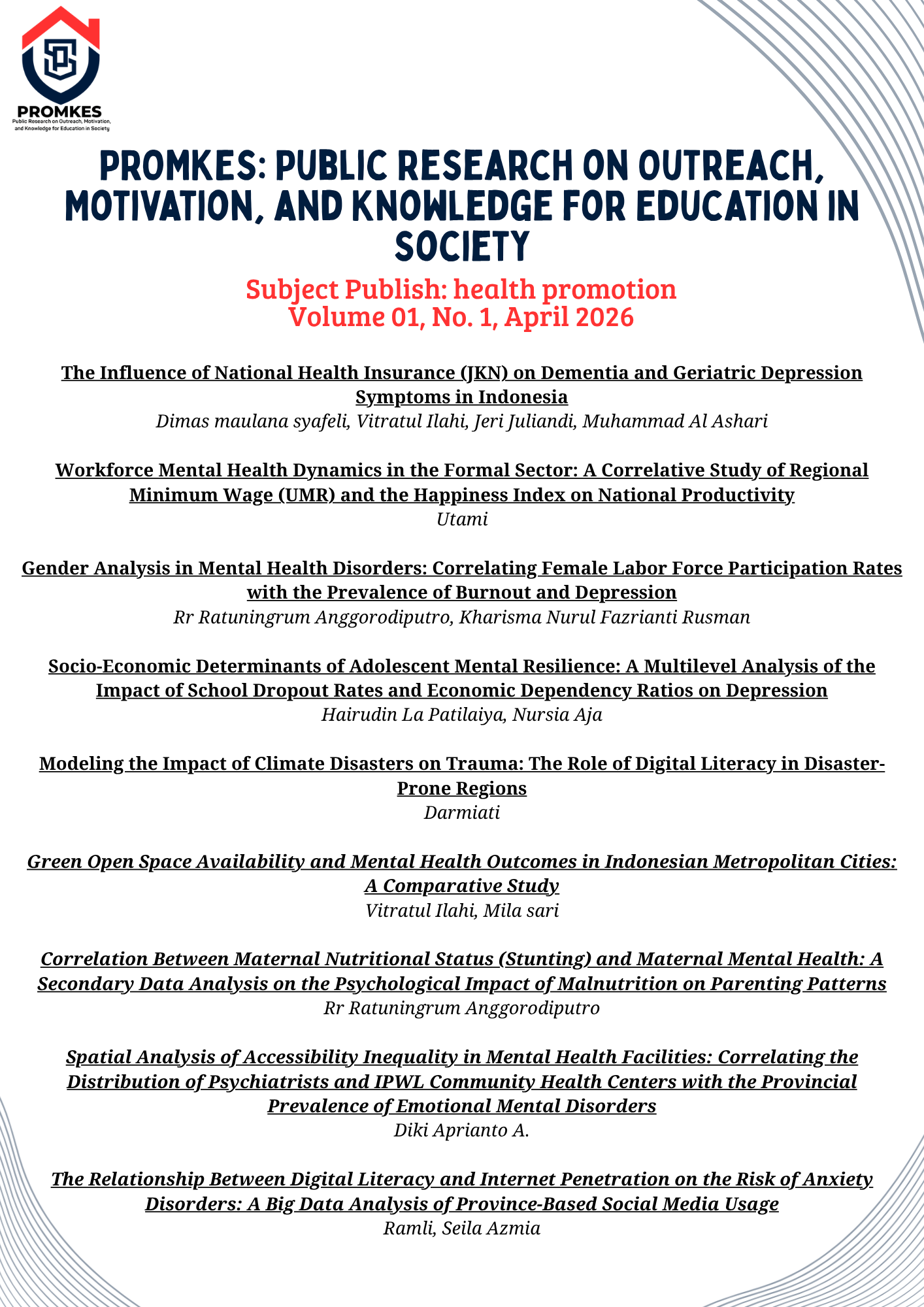
Spatial Analysis of Accessibility Inequality in Mental Health Facilities: Correlating the Distribution of Psychiatrists and IPWL Community Health Centers with the Provincial Prevalence of Emotional Mental Disorders
DOI:
https://doi.org/10.69855/promkes.v1i1.462Keywords:
Accessibility, Mental Health, GIS Analysis, IPWL Centers, Health PolicyAbstract
The treatment gap in mental health within archipelagic nations is exacerbated by geographical barriers and inequitable resource distribution. This study investigates the spatial correlation between provincial Emotional Mental Disorder (EMD) prevalence and the accessibility of psychiatric services across Indonesia. Utilizing a quantitative design, the research synthesized 2023–2025 secondary data from National Health Research (Riset Kesehatan Dasar, Riskesdas) and the One Health Data (Satu Data Kesehatan) portal across 38 provinces. Geographic Information System (GIS) mapping was employed to calculate the Provider-to-Population Ratio (PPR) for psychiatrists and Mandatory Reporting Institutions (Institusi Penerima Wajib Lapor, IPWL) centers. Results reveal a non-significant correlation (), exposing an urban bias where resources cluster in Java-Bali despite higher clinical needs in peripheral regions. Notably, Eastern Indonesia exhibits the highest EMD prevalence (13.50%) but the lowest specialist density (0.12 per 100,000 residents). Significant spatial autocorrelation (Moran's ) confirms that "service deserts" are geographically clustered. The study concludes that achieving equity requires a transition toward needs-based spatial planning and tele-psychiatry integration to bridge the distance gap in underserved territories.
References
Anselin, L. (2020). Spatial Analysis of Health Data: Methods and Applications. Oxford University Press. doi:https://doi.org/10.1093/oso/9780198849094.001.0001
Ayu, S. P. (2024). Public Health Policy and Mental Health Equity in Emerging Economies. Academic Press.
Azimi, S. &. (2025). Workforce allocation in urban community mental health services: GIS-based analytical insights for policy and planning. Healthcare, 13(17). doi:https://doi.org/10.3390/healthcare13172092
Faria, M. Z.-A. (2023). Mental health for all: The case for investing in digital mental health to improve global outcomes, access, and innovation in low-resource settings. Journal of Clinical Medicine. doi:https://doi.org/10.3390/jcm12216735
Fathmawati, F. A. (2023). Distribution of autistic children in Pontianak, West Kalimantan Province, Indonesia. Malaysian Journal of Public Health Medicine. doi:https://doi.org/10.37268/mjphm/vol.23/no.2/art.1826
Kalkan, A. &. (2022). Geographic Information Systems in Health Services Management. Springer Nature. doi:https://doi.org/10.1007/978-3-030-91237-6
Kementerian Kesehatan Republik Indonesia. (2023). Laporan Nasional Riset Kesehatan Dasar (Riskesdas). Lembaga Penerbit Badan Penelitian dan Pengembangan Kesehatan. doi:https://doi.org/10.22435/rkd.v1i1.456
Organization, World Health. (2021). Mental Health Atlas 2020. World Health Organization. Retrieved from https://apps.who.int/iris/handle/10665/345946
Statistik, B. P. (2024). Proyeksi Penduduk Indonesia 2020–2025: Hasil Sensus Penduduk 2020. BPS RI.
Sutar, R. P. (2024). Mapping the geographic inequalities in psychiatrist distribution across Madhya Pradesh, India: An exploratory study. Indian Journal of Psychological Medicine. doi:https://doi.org/10.1177/02537176241240022
Wang, L. &. (2021). Mental health crisis and spatial accessibility to mental health services in the city of Toronto: A geographic study. 1(2), 191–213. doi:https://doi.org/10.32920/IHTP.V1I2.1427
Wong, S. L. (2021). Spatial Statistics for Public Health Research. doi:https://doi.org/10.1002/9781119156391
Cromley, E. K., & McLafferty, S. L. (2012). GIS and public health (2nd ed.). New York, NY: Guilford Press.
Guagliardo, M. F. (2004). Spatial accessibility of primary care: Concepts, methods and challenges. International Journal of Health Geographics, 3(1). doi:https://doi.org/10.1186/1476-072X-3-3
Luo, W., & Qi, Y. (2009). An enhanced two-step floating catchment area (E2SFCA) method for measuring spatial accessibility to primary care physicians. Health & Place, 15(4), 1100–1107. doi:https://doi.org/10.1016/j.healthplace.2009.06.002
Downloads
Published
How to Cite
Issue
Section
License
Copyright (c) 2026 PROMKES: Public Research on Outreach, Motivation, and Knowledge for Education in Society

This work is licensed under a Creative Commons Attribution 4.0 International License.