
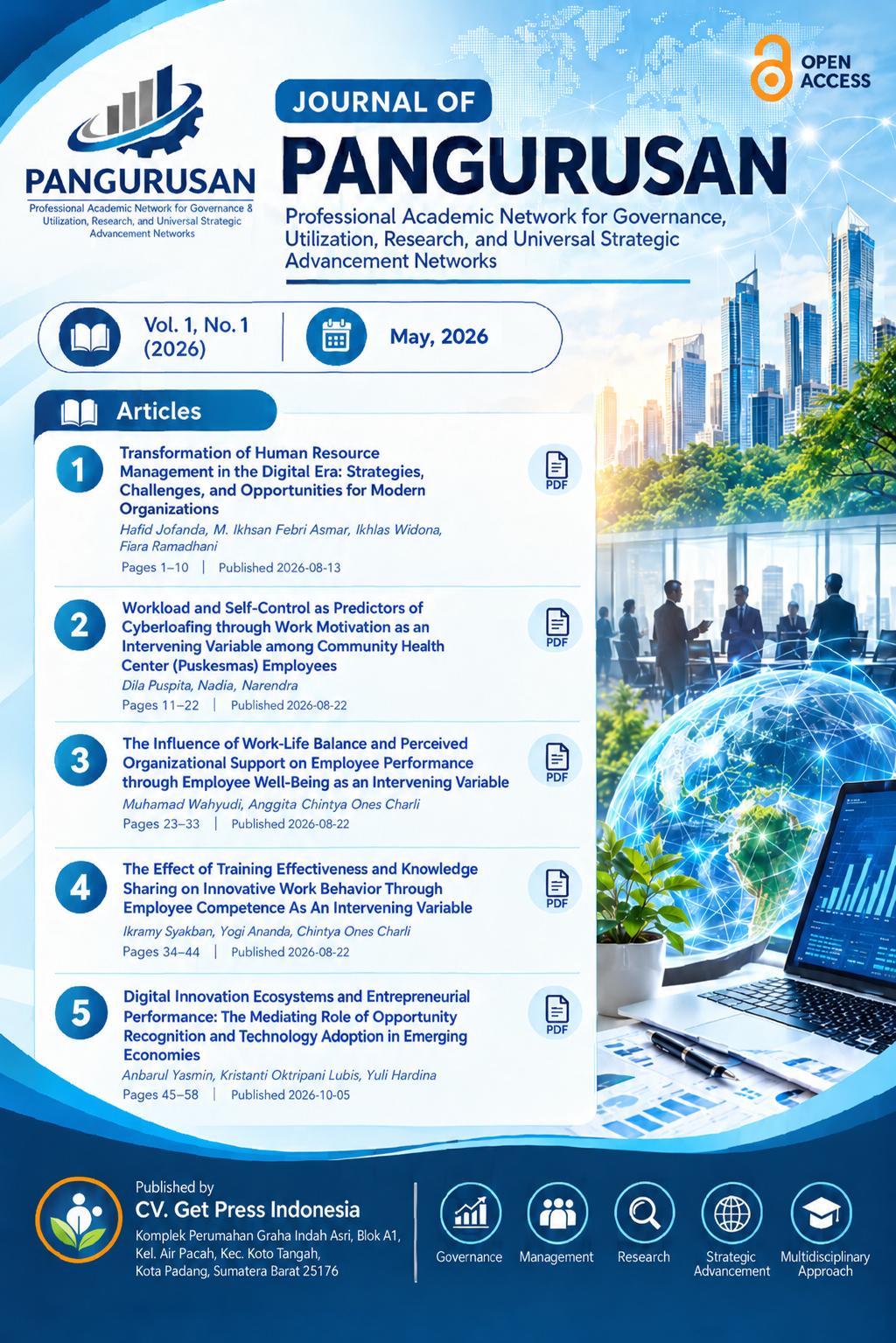
Transformation of Human Resource Management in the Digital Era: Strategies, Challenges, and Opportunities for Modern Organizations
Keywords:
Human Resource Management, Digital Transformation, HR-Tech, Competency Development, Organizational Culture, Transformational LeadershipAbstract
Human Resource Management (HRM) is undergoing a fundamental transformation in an era of accelerating digitalization. This study examines how modern organizations adapt their HRM practices in the face of technological disruption, shifting workforce demographics, and an increasingly complex business environment. Employing a comprehensive literature review and comparative analysis of 45 organizations in Indonesia, this research finds that the success of HRM transformation is determined by three primary pillars: transformational leadership, strategic adoption of HR technology (HR-Tech), and the cultivation of an adaptive organizational culture. Results indicate that organizations investing more than 5% of their operating budget in human capital development achieved an average productivity improvement of 34% and reduced employee turnover by up to 28%. The practical implications of this study provide strategic guidance for HRM practitioners in designing relevant and sustainable human capital development programs for the digital age.
References
Armstrong, M., & Taylor, S. (2020). Armstrong's handbook of human resource management practice (15th ed.). Kogan Page.
Barney, J. B., & Clark, D. N. (2020). Resource-based theory: Creating and sustaining competitive advantage. Oxford University Press.
Boateng, G. O., Neilands, T. B., Frongillo, E. A., Melgar-Quiñonez, H. R., & Young, S. L. (2018). Best practices for developing and validating scales for health, social, and behavioral research: A primer. Frontiers in Public Health, 6, 149.
Braun, V., & Clarke, V. (2022). Thematic analysis: A practical guide. SAGE Publications.
Budhwar, P., Chowdhury, S., Wood, G., Aguinis, H., Bamber, G. J., Beltran, J. R., et al. (2024). Artificial intelligence and human resource management: A review and research agenda. Human Resource Management Journal, 34(3), 606–659.
Castleberry, A., & Nolen, A. (2018). Thematic analysis of qualitative research data: Is it as easy as it sounds? Currents in Pharmacy Teaching and Learning, 10(6), 807–815.
Chowdhury, S., Dey, P. K., Joel-Edgar, S., Bhattacharya, S., & Kharlamov, A. (2023). Unlocking the value of artificial intelligence in human resource management. The International Journal of Human Resource Management, 34(14), 2732–2764.
Creswell, J. W., & Creswell, J. D. (2018). Research design: Qualitative, quantitative, and mixed methods approaches (5th ed.). SAGE Publications.
Deloitte. (2023). 2023 Southeast Asia human capital trends. Deloitte Consulting.
Garvin, D. A. (2016). Building a learning organization. Harvard Business Review Press. (Original work published 1993)
Guetterman, T. C., Fetters, M. D., & Creswell, J. W. (2015). Integrating quantitative and qualitative results in health science mixed methods research through joint displays. The Annals of Family Medicine, 13(6), 554–561.
Hair, J. F., Hult, G. T. M., Ringle, C. M., & Sarstedt, M. (2021). A primer on partial least squares structural equation modeling (PLS-SEM) (3rd ed.). SAGE Publications.
Hamidah, H., & Fatimah, S. (2025). Digital HRM practices in Indonesian organizations: Challenges and opportunities. Journal of Digital Business Management, 12(1), 45–62.
Heifetz, R. A., Grashow, A., & Linsky, M. (2019). Adaptive leadership: Mobilizing people to tackle tough challenges. Harvard Business Review Press.
Hiatt, J. M. (2020). Change management: The people side of change (2nd ed.). Prosci Learning Center.
Indonesian Chamber of Commerce and Industry. (2024). Indonesia HRM transformation report 2024. KADIN Publications.
Indonesian Ministry of Manpower. (2024). Laporan transformasi digital ketenagakerjaan Indonesia 2024. Kementerian Ketenagakerjaan Republik Indonesia.
Ivankova, N. V. (2020). Mixed methods applications in action research: From methods to community action. SAGE Publications.
Joshi, A., Kale, S., Chandel, S., & Pal, D. K. (2015). Likert scale: Explored and explained. British Journal of Applied Science & Technology, 7(4), 396–403.
Kallio, H., Pietilä, A. M., Johnson, M., & Kangasniemi, M. (2016). Systematic methodological review: Developing a framework for a qualitative semi-structured interview guide. Journal of Advanced Nursing, 72(12), 2954–2965.
Kane, G. C., Nanda, R., Phillips, A. N., & Copulsky, J. R. (2021). The transformation myth: Leading your organization through uncertain times. MIT Press.
Kotter, J. P. (2019). On change management. Harvard Business Review Press.
McKinsey Global Institute. (2022). Performance through people: Transforming human capital into competitive advantage. McKinsey & Company.
Memon, M. A., Ting, H., Cheah, J.-H., Thurasamy, R., Chuah, F., & Cham, T. H. (2020). Sample size for survey research: Review and recommendations. Journal of Applied Structural Equation Modeling, 4(2), i–xx.
Noe, R. A., Hollenbeck, J. R., Gerhart, B., & Wright, P. M. (2020). Fundamentals of human resource management (8th ed.). McGraw-Hill Education.
Prasetyo, B., & Trisyanti, U. (2018). Revolusi industri 4.0 dan tantangan perubahan sosial. IPTEK Journal of Proceedings Series, 5, 22–27.
Sarstedt, M., Hair, J. F., Pick, M., Liengaard, B. D., Radomir, L., & Ringle, C. M. (2022). Progress in partial least squares structural equation modeling use in marketing research in the last decade. Psychology & Marketing, 39(5), 1035–1064.
Sekaran, U., & Bougie, R. (2019). Research methods for business: A skill-building approach (8th ed.). Wiley.
Shorten, A., & Smith, J. (2017). Mixed methods research: Expanding the evidence base. Evidence-Based Nursing, 20(3), 74–75.
Stone, R. J., Cox, A., & Gavin, M. (2021). Human resource management (10th ed.). Wiley.
Strohmeier, S. (2020). Digital human resource management: A conceptual clarification. German Journal of Human Resource Management, 34(3), 345–365.
Suryani, T., Fauzi, A., & Nurhayati, M. (2023). Digital competency gaps in Indonesian HRM practice. Asian Journal of Business Research, 13(2), 88–104.
Tashakkori, A., & Teddlie, C. (2021). Foundations of mixed methods research: Integrating quantitative and qualitative approaches in the social and behavioral sciences (2nd ed.). SAGE Publications.
Teece, D. J. (2022). Dynamic capabilities: How to build and sustain competitive advantage. Oxford University Press.
Vial, G. (2019). Understanding digital transformation: A review and a research agenda. The Journal of Strategic Information Systems, 28(2), 118–144.
Vrontis, D., Christofi, M., Pereira, V., Tarba, S., Makrides, A., & Trichina, E. (2022). Artificial intelligence, robotics, advanced technologies and human resource management: A systematic review. The International Journal of Human Resource Management, 33(6), 1237–1266.
World Economic Forum. (2023). The future of jobs report 2023. World Economic Forum.
Downloads
Published
How to Cite
Issue
Section
License
Copyright (c) 2026 Professional Academic Network for Governance, Utilization, Research, and Universal Strategic Advancement Networks (PANGURUSAN)

This work is licensed under a Creative Commons Attribution 4.0 International License.